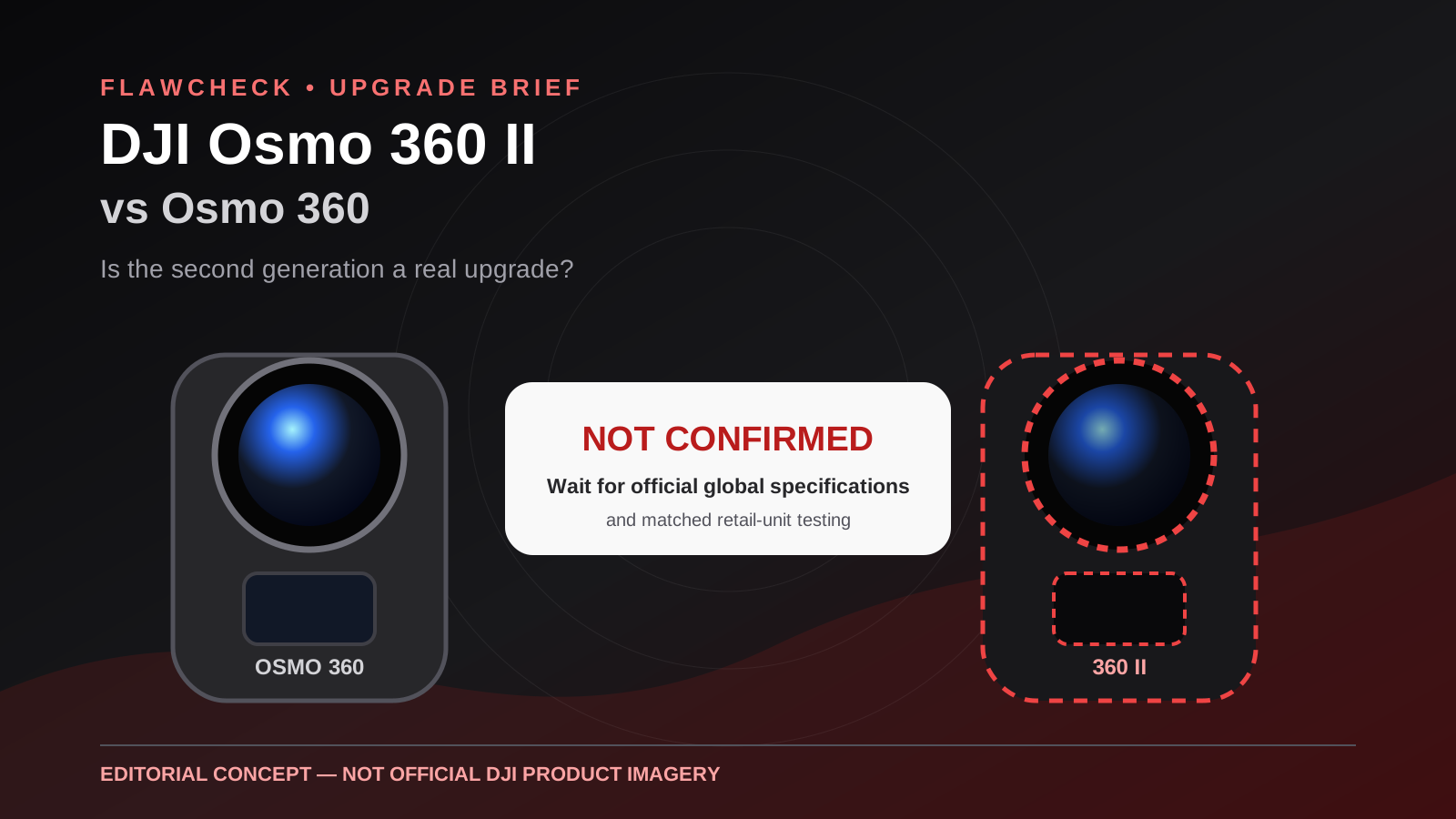
Launch evidence notice (September 3, 2026): DJI has launched Osmo 360 II globally. Confirmed claims below come from DJI official materials; matched real-world testing is still required.
DJI does not need to make the second Osmo 360 merely more powerful. It needs to make the expensive parts of owning and using a 360 camera less frustrating.
The original Osmo 360 already offers native 8K panoramic capture, a high-resolution photo mode, built-in storage, a replaceable battery and DJI’s magnetic mounting ecosystem. That leaves a difficult upgrade question. A new frame-rate headline is not enough if close subjects still stitch poorly, low-light footage still requires aggressive processing, sustained recording still creates heat limits, or owners must replace batteries and protection accessories.
If you prefer a conventional framed camera with a physical gimbal and much simpler editing, read our DJI Osmo Pocket 3 downside review before choosing a 360 camera.
Our launch position is conservative: existing Osmo 360 owners should not commit to an upgrade until the practical improvements and switching costs are verified.
DJI Osmo 360 II vs Osmo 360: confirmed specification table
| Item | DJI Osmo 360 II | DJI Osmo 360 | Status and buying relevance |
|---|---|---|---|
| Global launch status | Launched globally September 3, 2026 | Launched July 31, 2025 | Regional stock and pricing still vary |
| Global/US price | Not confirmed | Verify current regional checkout price | Launch prices and imports can distort the upgrade cost |
| Dimensions | Not confirmed | 61 × 36.3 × 81mm | Similar appearance does not prove case compatibility |
| Weight | 183g | 183g | No published weight reduction |
| Sensor | 1-inch square HDR sensor; 2.4 μm pixels | 1/1.1-inch CMOS, square sensor design | DJI claims 14.5 stops; matched tests needed |
| Aperture | Not confirmed | f/1.9 | Confirm per-lens specification |
| Maximum panoramic video | 8K up to 60fps | 8K up to 50fps; 6K up to 60fps | Confirmed frame-rate upgrade |
| Maximum panoramic photo | 120MP HDR 360° | 120MP | HDR is new; resolution alone is not usable detail |
| Maximum bitrate | Not confirmed | 170Mbps | Codec efficiency and processing also matter |
| Built-in storage | 105GB usable | 128GB; 105GB available | Effectively unchanged usable space |
| microSD support | Not confirmed | Up to 1TB on DJI’s compatibility list | Card requirements affect ownership cost |
| Minimum stitching distance | Not confirmed | At least 0.75m recommended | Critical for hands, faces and close objects |
| Battery capacity | Not confirmed | 1,950mAh / 7.5Wh | Capacity cannot predict runtime alone |
| Claimed 8K/30 runtime | Up to 100 minutes | Up to 100 minutes in DJI lab conditions | No headline endurance gain |
| Operating temperature | Not confirmed | -20°C to 45°C | Does not prove sustained high-resolution recording |
| Waterproof rating | 10m; optional case to 50m | IP68; body rated to 10m | Underwater stitching still needs caution |
| Wi-Fi / USB | Not confirmed | Wi-Fi 6; USB 3.1 Type-C | Transfer speed affects the real editing workflow |
| Battery compatibility | Not confirmed | Original Osmo 360 battery | Verify exact model numbers |
| Mount/accessory compatibility | Dual-direction magnetic quick-release; 1/4-inch thread | DJI magnetic quick-release ecosystem | Verify each accessory model number |
| Warranty and DJI Care | Not confirmed by market | Market-dependent | Especially important for convex-lens damage |
Verification note: fields still marked Not confirmed are limited to details not stated clearly in the official global launch materials. They are intentionally not filled from leaks or copied retailer listings.
1. Limitations of the original Osmo 360
The first-generation camera sets a strong specification baseline, but its ownership risks create the real upgrade test.
The convex lenses remain exposed. A scratch can be more consequential than cosmetic body damage, and transparent protectors can introduce reflections, softness or fogging. DJI also recommends keeping subjects at least 0.75m away for optimal panoramic stitching. That matters because many 360-camera failures happen close to hands, faces, handlebars, vehicle panels and selfie-stick attachments.
Underwater capability needs similar caution. DJI rates the body to 10m under specified conditions, while warning that refraction around the fisheye lenses may create distortion and stitching errors. Waterproof does not mean underwater footage will stitch cleanly.
The original camera also produces demanding files. Native 8K capture, high bitrates and 120MP photos can pressure storage, transfer time, phone thermals and desktop export performance. Buyers should judge the entire workflow, not only the camera body.
2. What Osmo 360 II must fix
A worthwhile successor must improve problems that owners encounter after the honeymoon period:
- More reliable stitching around hands, faces and moving subjects.
- Better usable detail after reframing, not merely a larger capture specification.
- Cleaner shadows and fewer processing artifacts in mixed or low light.
- Longer sustained high-resolution recording without thermal shutdown.
- Faster preview, transfer, editing and export.
- Better protection or repair economics for vulnerable lenses.
- Clear backward compatibility for batteries, mounts and accessories.
- Predictable regional pricing, warranty and DJI Care coverage.
If DJI improves only the headline recording mode while leaving these costs unchanged, the second generation will be easier to recommend to new buyers than to existing owners.
3. Image quality and low-light recording
Confirmed for Osmo 360: DJI lists a 1/1.1-inch CMOS sensor, f/1.9 aperture, native 8K panoramic modes and a dedicated SuperNight mode.
Those specifications do not settle the comparison. The final article needs matched scenes with the same exposure strategy, movement, stabilization and export resolution. Check:
- Fine detail after reframing to a normal 16:9 view.
- Noise and texture smearing in shadows.
- Highlight clipping around streetlights and windows.
- Color and exposure differences across the stitch line.
- Ghosting around moving subjects.
- Sharpness near each lens edge.
- Processing consistency between standard and low-light modes.
Osmo 360 II launch claim: 14.5 stops of dynamic range and AI SuperNight 2.0. These are manufacturer claims, not a controlled comparison.
4. Temperature, battery and recording time
DJI states that the original camera can record up to 100 minutes of 8K/30 panoramic video under controlled conditions with several wireless and intelligent features disabled and the screen off. That is a laboratory reference, not a promise for hot weather, active preview, stabilization, file transfer or repeated clips.
The successor must be tested for:
- Time to thermal warning or shutdown at its highest useful mode.
- Runtime with screen, Wi-Fi and normal controls enabled.
- Recovery time after overheating.
- Charging behavior while warm.
- Battery drain during standby and transfer.
- Whether higher frame-rate modes impose a severe endurance penalty.
Osmo 360 II launch claim: up to 100 minutes at 8K/30 and 80% charge in 22 minutes. Independent thermal behavior remains unverified.
5. Software, stitching and workflow
A 360 camera sells the promise of choosing the frame later. That promise creates extra work: transferring large source files, setting keyframes, tracking subjects, correcting horizons, hiding stitch artifacts, exporting and archiving both source and final footage.
The final comparison should test DJI Mimo and desktop workflow separately. Record app version, phone/computer hardware and export settings. Confirm whether the new camera changes:
- Mobile preview resolution and responsiveness.
- Automatic subject tracking.
- Stitching quality near the minimum distance.
- Batch export and background processing.
- Proxy generation.
- Premiere Pro and DaVinci Resolve workflow.
- File format and backward compatibility with existing projects.
A faster camera that creates slower post-production is not automatically an upgrade.
6. Accessories and switching cost
The body price is only the first line of the bill. Calculate:
| Switching-cost item | Compatibility/status |
|---|---|
| Existing Osmo 360 batteries | Not confirmed |
| Multifunctional battery case | Not confirmed |
| Magnetic quick-release mounts | Not confirmed |
| Invisible selfie sticks | Not confirmed |
| Transparent lens protectors | Not confirmed |
| Protective case or cage | Not confirmed |
| Waterproof accessories | Not confirmed |
| DJI Mic direct connection | Not confirmed |
| Existing microSD cards | Not confirmed |
| DJI Care transfer or replacement terms | Not confirmed |
Do not accept “same ecosystem” as proof. Verify exact accessory model numbers and identify which items require repurchase. A modest camera-body premium can become an expensive upgrade once batteries and protection are added.
7. Who should not upgrade?
Do not upgrade immediately if:
- Your Osmo 360 already delivers acceptable daylight footage.
- Your main problem is editing time rather than capture quality.
- You recently bought multiple batteries, protectors or a dedicated cage.
- You mostly export to 1080p social media.
- You expect a specification increase to eliminate every stitch artifact.
- You need proven hot-weather endurance.
- You rely on warranty support in a market without confirmed official sales.
- You cannot test whether your computer handles the new recording modes.
New buyers should also avoid a launch-day purchase when retailer warranty, DJI Care eligibility or regional firmware support is unclear.
8. Launch verdict
Wait for independent tests before upgrading.
The original Osmo 360 already has enough capture resolution that a responsible upgrade case must be built on better usable image quality, low-light consistency, stitching, thermal behavior, workflow and ownership cost. Those improvements need official documentation and matched testing.
Our final verdict will use three thresholds:
- Upgrade: clearly better practical output plus acceptable switching cost.
- Wait for discount/firmware: meaningful gains undermined by price, heat or workflow limitations.
- Keep Osmo 360: improvements are narrow, unproven or too expensive after accessories.
The official feature list is now clear; the remaining decision depends on independent evidence rather than additional launch-day specifications.
9. FAQ
The FAQ reflects DJI’s September 3 global launch. Image quality, heat, stitching, battery and compatibility conclusions remain provisional until controlled tests are available.
10. Sources and disclosure
Confirmed original-model specifications were checked against DJI’s Osmo 360 specifications, official product page, download center, and beginner workflow guide on September 2, 2026.
DJI launched Osmo 360 II globally on September 3, 2026. Confirmed claims are cited from DJI’s global launch announcement and Osmo 360 II product page. Price, stock, warranty and accessories remain regional.
FlawCheck has not tested Osmo 360 and Osmo 360 II side by side. Manufacturer claims must be labeled as claims; real-world image quality, battery life, thermals and stitching remain provisional until matched retail-unit evidence exists. See our methodology, editorial policy and corrections policy.