2x Optical-Quality Zoom vs Real Telephoto: What Are You Actually Losing?
A 2x crop can look excellent in daylight, but it is not a dedicated telephoto. See what changes in low light, motion, portraits and useful reach.
Decision in 30 seconds
What matters most
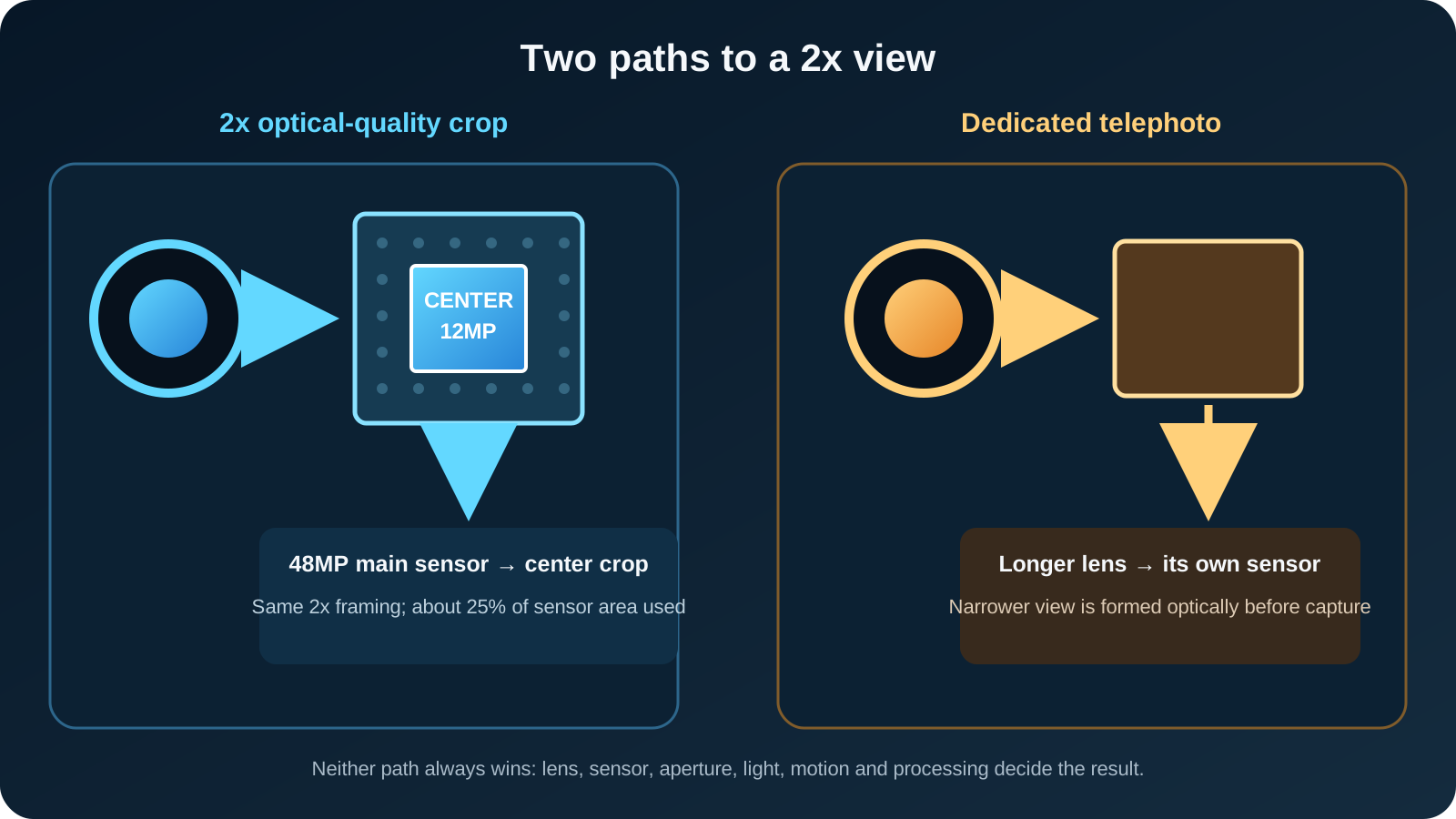
- ✓ A 2x crop from 48MP keeps the central 12MP, so it can avoid basic upscaling while using only about one quarter of the sensor area.
- ✓ A dedicated telephoto forms a narrower view optically on its own sensor, but its sensor size, aperture, focus and stabilization still determine quality.
- ✓ The crop penalty usually appears first in dim light, motion, repeated texture, video and any attempt to zoom beyond 2x.
- ✓ At the same camera position and framing, crop and telephoto do not create different perspective; shooting distance creates the familiar compression effect.
- ✓ If most of your photos are static 2x shots in good light, optical-quality crop may be enough; regular 3x–5x use still favors dedicated hardware.
How we selected
- Separates native-resolution sensor crop, dedicated telephoto, interpolated digital zoom and multi-frame hybrid zoom
- Evaluates daylight, indoor, night, motion, portrait and video use rather than judging from resolution labels alone
- Uses official documentation for mechanisms without treating manufacturer quality claims as independent testing
Bottom line
A good 48MP-to-12MP crop is a useful 2x shortcut, not a replacement for every real telephoto camera. It gives up sensor area and has no native reach beyond 2x; the penalty is easiest to expose with dim light, moving subjects, fine texture and further cropping. Yet a small, slow telephoto can still lose to a strong main-camera crop. Buy the complete camera system, not the label.
A 2x button can be one of the most honest-looking traps on a phone camera. Tap it in daylight and the image may be sharp, full-size and immediately convincing. The specification may even call it “2x Telephoto” or “2x optical-quality zoom.” It is easy to conclude that a separate telephoto camera is unnecessary.
That conclusion holds only under friendly conditions.
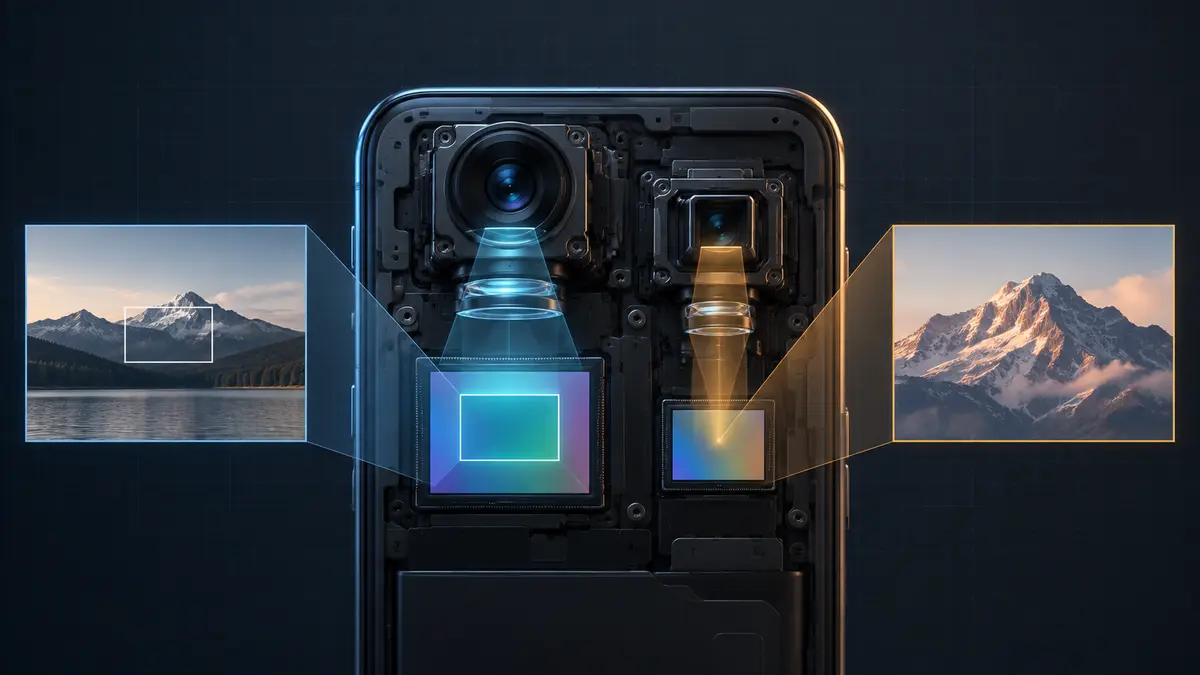
On many phones, 2x is the central 12 megapixels of a 48MP main sensor. This is smarter than enlarging a 12MP 1x photo: enough sampled pixels remain to make a 12MP output without straightforward upscaling. But the lens has not become longer, only about one quarter of the sensor area contributes to the crop, and anything beyond 2x needs another crop or computational reconstruction.
The downside is not that every 2x crop looks bad. It is that a clean daylight result can hide the situations where dedicated reach matters: a child moving indoors, a performer across a dark room, hair and fabric in a portrait, distant lettering, or video that cannot wait for several frames to be merged.
The short answer
2x optical-quality zoom is not the same capture mechanism as a real telephoto camera. A typical version crops the center of a high-resolution main sensor. A dedicated telephoto uses a physically longer lens to project a narrower field of view onto a separate sensor.
The crop can be excellent at 2x in good light. It can even beat a poor telephoto module. What it cannot provide is guaranteed telephoto quality or native reach beyond its crop limit.
FlawCheck buying rule: if 2x is only a convenient framing button for daylight photos, a strong main-camera crop may be enough. If you regularly need 3x–5x, dim-light motion or distant fine detail, buy verified telephoto hardware—and verify that the phone actually uses it in those conditions.
How a 48MP sensor becomes a 12MP 2x camera
Imagine a 48MP sensor with approximately 8,000 × 6,000 photosites. A 2x linear crop keeps half the width and half the height: roughly 4,000 × 3,000, or 12MP.
That is why the result can still be a genuine 12MP file. The phone is not necessarily taking a 3MP crop and stretching it back to 12MP. It has enough sample positions in the middle of the high-resolution sensor.
The area math is less flattering. Half the width multiplied by half the height equals one quarter of the area. The 2x frame uses about 25% of the full sensor, discarding the outer 75% for that composition. It also gives up the full-sensor oversampling or pixel-grouping options available to the 1x capture.
Apple describes 2x on supported models as a telephoto view “enabled by” the quad-pixel sensor rather than a separate physical camera. Samsung similarly distinguishes “2x Optical Quality Zoom” from the native optical distance of its dedicated telephoto module. These descriptions establish how the modes are built; they do not independently prove equivalent image quality.
This mechanism is covered more broadly in our guide to optical-quality zoom versus optical zoom. The question here is narrower: what can you actually lose by relying on the crop?
What you actually lose with 2x optical-quality zoom
1. Low-light detail can run out sooner
Bright light makes a 2x crop look easy. The camera can use low gain, a fast shutter and the sharp center of the main lens. On a phone display or social feed, the result may be indistinguishable from a dedicated 2x camera.
Dim light removes that comfort. Using a smaller sensor region reduces the total scene information available to the output. The phone may raise gain, extend exposure, merge more frames and apply stronger noise reduction. Static buildings can survive this pipeline; hair, fabric, foliage and skin texture may turn waxy or watercolor-like.
This is not proof that a telephoto always wins at night. Many phone telephotos use a smaller sensor and a narrower aperture than the main camera. In poor light, the camera app may decide that cropping the main sensor is safer than switching modules. The honest comparison is therefore not “crop versus the word optical.” It is a matched comparison of both complete camera paths.
2. Freezing motion becomes harder
Night modes and multi-frame fusion are excellent at rescuing stationary scenes. They are less reliable when the subject changes between frames.
A child turning their head, a pet running indoors or a musician moving under stage lighting can force a tradeoff. A faster shutter preserves motion but collects less light; a slower shutter collects more light but blurs the subject. Stronger denoising can hide grain while erasing the texture you wanted the zoom for.
A good telephoto with effective stabilization and enough aperture gives the camera a better optical starting point. But stabilization corrects camera movement, not the subject’s movement. Reviews should report shutter speed, subject motion and keeper rate rather than showing one successful frame.
3. Noise reduction and sharpening become more visible
Phone images often look detailed because edges are sharpened, contrast is increased locally and several frames are fused. At 2x, those tools have less raw spatial information to work with than a full-sensor 1x image.
Repeated textures reveal the weakness first: hair, grass, roof tiles, brick, mesh and distant text. Processing may draw a crisp boundary around an object while flattening the small variations inside it. The thumbnail looks sharp; the original file looks brittle.
If the saved image appears crunchier than the preview, the broader problem may be computational rendering rather than the zoom mechanism alone. Our guide to why iPhone photos look overprocessed explains what the native Camera app lets you change—and what it does not.
4. Depth of field and “compression” are easy to misunderstand
A longer physical lens can change optical depth-of-field behavior, especially when its sensor, aperture, subject distance and focus distance differ from the main camera. That can help portraits look less like a wide-camera crop and give hair or object edges a more natural transition before software blur is added.
But telephoto “compression” needs careful language. If two cameras are used from exactly the same position and produce the same framing, their perspective relationships are essentially the same. The familiar compressed background appears because a photographer stands farther away and reframes with a longer view—not because a telephoto label independently rearranges the scene.
For buyers, the practical advantage is flexibility. A dedicated 3x or 5x camera lets you stand farther away while keeping the subject large in the frame. A 2x-only phone may force you closer or require a lower-quality crop.
5. Portrait quality has more failure points
Two-times framing is attractive for portraits because it avoids the exaggerated close-up perspective of a wide 1x camera. In daylight, a high-quality crop can be entirely sufficient for people, food and street details.
Indoors, the differences become harder to hide. Skin texture competes with noise reduction, moving hands compete with multi-frame alignment, and artificial portrait blur must separate glasses, hair and clothing from the background. A physically longer camera does not guarantee a perfect portrait, but it can supply more native detail at a comfortable shooting distance.
Judge complete faces at normal viewing size before inspecting 100% crops. Excess sharpening can make eyelashes look impressive while skin and hair look artificial.
6. Useful shooting distance stops at 2x
The largest structural loss is reach. A clean 2x crop has already spent most of its high-resolution headroom. Moving to 3x, 4x or 5x means using an even smaller region, enlarging the result, fusing frames or attempting to reconstruct texture.
A dedicated telephoto begins those distances with optical magnification. That does not make unlimited zoom good, but it gives the pipeline a stronger starting point. Concerts, school sports, architectural details and travel landmarks are where “I rarely zoom” can become “I cannot get closer.”
The camera tradeoff is especially relevant when comparing Apple’s folding and Pro models. Our iPhone Duo versus iPhone 18 Pro camera comparison separates the foldable’s workflow advantages from the Pro’s more complete focal-length hardware.
1x, 2x optical-quality and real telephoto compared
| Decision point | 1x full main camera | 2x optical-quality crop | Dedicated telephoto |
|---|---|---|---|
| How framing changes | Full main-lens view | Center of main sensor retained | Longer lens forms narrower view |
| Typical sensor use | Full paired sensor | About 25% for a 2x linear crop | Full paired telephoto sensor |
| 12MP output possible without basic enlargement? | Yes | Yes, when starting near 48MP | Yes, at native output |
| Daylight | Strongest main-camera baseline | Often excellent | Depends on tele lens and sensor quality |
| Indoor and night | Best main-camera light budget | Less crop headroom; more processing risk | Can win, but a small/dim module may lose or be bypassed |
| Motion | Usually most reliable camera path | Frame fusion and denoising can smear | Better reach; shutter choice still matters |
| Portrait working distance | May require standing close | Comfortable for casual 2x portraits | Better flexibility at 3x–5x |
| Zoom beyond native step | Digital/hybrid crop | Degrades beyond 2x | Starts farther ahead optically |
| Main buying risk | Wide perspective for close portraits | Label can imply hardware that is not present | Extra camera may be weak or unused in low light |
The table deliberately avoids crowning a universal winner. A large main sensor with a bright lens can outperform a cheap telephoto. Conversely, a well-designed telephoto can preserve detail that no amount of sharpening can recover from a deeper crop.
When a 2x crop is good enough
You may not need a dedicated telephoto if most of these statements are true:
- You take most photos outdoors or in bright interiors.
- Your common zoom position is exactly 2x, not 3x–5x.
- Subjects are mostly stationary.
- Images are shared on messaging apps and social media rather than printed or heavily cropped.
- You value a thinner, lighter or less expensive phone more than distant reach.
- You have checked full-resolution samples from the exact model, not merely another phone using a 48MP sensor.
For food, documents, products, casual portraits and street framing, a good 2x crop is not a fake feature. It can be the most practical focal-length button on the phone.
When to choose a phone with real telephoto hardware
Prioritize a dedicated telephoto if you regularly photograph subjects you cannot approach: concerts, wildlife, school performances, sports, travel details or architecture. It also matters when 3x–5x is part of your normal visual style rather than an emergency zoom.
Portrait photographers should compare working distance, skin texture, hair edges and motion indoors. Video users should check whether the telephoto is available at the required resolution and frame rate, whether lens switching changes color or exposure, and whether stabilization remains effective.
Do not buy from lens count alone. Look for the telephoto’s native equivalent focal length, sensor resolution, aperture, autofocus and stabilization. Then check whether reviewers observed the phone falling back to the main camera in dim light or at close focus.
New optical hardware can introduce its own unanswered questions. The iPhone 18 Pro variable-aperture camera analysis shows why a real mechanism still requires matched retail evidence before it deserves a win—or a Flaw Score.
Phone-camera buying checklist
Before paying more for zoom, answer these questions:
- Which focal lengths are native? List the equivalent focal length of each physical camera, not every button in the app.
- What creates the 2x view? A separate module, a 48MP center crop, or an interpolated image?
- What do you actually photograph? Daylight buildings are an easy test; indoor motion, hair, fabric and signs are more revealing.
- How often do you use 3x–5x? A 2x crop cannot replace reach you repeatedly need.
- Does the telephoto operate in low light? Check metadata and repeated tests rather than assuming the marked lens is active.
- Are stills and video equally supported? Resolution, frame rate, stabilization and lens switching can differ.
- Can you inspect originals? Downsized samples conceal noise reduction and invented texture.
- Is the upgrade solving a real limitation? Do not pay for a camera label if your real complaint is processing style, shutter lag or storage.
Verdict
The best 2x optical-quality modes deserve more credit than ordinary pinch-to-zoom. A 48MP main sensor can retain a native 12MP center region, use the sharp center of the lens and produce a strong image without basic enlargement. For static subjects in good light, that may be all the telephoto capability many owners need.
But a full-size file is not proof of an equivalent capture. The crop uses about one quarter of the sensor area, loses oversampling headroom and reaches its native-resolution limit at 2x. Dim light, subject motion, repeated texture, video and further zoom expose the compromise.
A dedicated telephoto is also not automatically superior. If its sensor is tiny, its lens is dim or the software refuses to use it, a main-camera crop may win. The responsible question is not “crop or optical?” in isolation. It is which complete camera path delivers a reliable keeper in the scenes you actually shoot?
If your life happens mostly at 1x and 2x in daylight, keep the simpler phone. If your subjects are distant, moving or poorly lit—and 3x–5x is routine—real telephoto hardware is the safer buy.
Sources and disclosure
Mechanism and terminology were checked on September 14, 2026 against Apple’s iPhone 15 technical specifications, which describe 2x as enabled by the quad-pixel sensor; Apple’s iPhone 15 Pro announcement, which separately documents a dedicated 3x telephoto; and Samsung’s Galaxy S25 camera specifications, which distinguish 2x optical-quality from 3x optical zoom.
Google’s Super Res Zoom research supports the distinction between a simple crop and a multi-frame computational zoom pipeline. DPReview’s analysis of optical-quality wording informed the terminology critique. Manufacturer sources establish hardware and claimed behavior, not independent image-quality equivalence.
FlawCheck has not claimed hands-on testing for this guide and assigns no numerical score. Actual results vary with sensor dimensions, lens transmission, readout, stabilization, exposure logic and processing. Conclusions that require matched retail samples are labeled as conditional rather than verified product defects.
Frequently Asked Questions
Direct answers to common buyer concerns and uncertainties.
Is 2x optical-quality zoom the same as a real telephoto camera?
No. A common 2x optical-quality mode takes the central 12MP from a 48MP main sensor. A real telephoto uses a physically longer lens and its own sensor to form a narrower view before capture. Both can produce good 12MP files, but the capture paths are different.
Is 2x sensor crop really optical zoom?
The lens does not change focal length, so it is not optical zoom in the traditional mechanism-based sense. It is better described as a native-resolution sensor crop when enough photosites remain for the output file.
Does 2x zoom lose quality in low light?
It can. A 2x center crop uses about one quarter of a 48MP sensor's area, reducing the light and oversampling available to the final frame. Processing can help static scenes, but motion, noise and fine texture are harder to recover. Results vary by phone.
Do I need a telephoto lens on my phone?
You probably do if you frequently photograph concerts, travel details, sports, pets, children or portraits from 3x to 5x. If almost all your photos are 1x or 2x in good light and shared at small sizes, a strong main-camera crop may be sufficient.
Can a 2x crop be better than a dedicated telephoto?
Yes. A large, bright main camera can beat a tiny telephoto with a dim lens, especially indoors where the phone may avoid the telephoto module entirely. Dedicated does not automatically mean better; matched samples at the exact zoom and light level matter.

Written by FlawCheck Editorial Desk
Editorial ResearchFlawCheck's editorial desk is responsible for source review, claim labeling, buyer-risk analysis, publication updates, and corrections. Current articles are research-based unless a documented hands-on method is explicitly provided.
Reviews behind this guide
View All Reviews →
Apple iPhone 18 Pro
"The iPhone 18 Pro is now a confirmed $1,199 flagship with meaningful hardware changes, but launch specifications do not prove that those changes improve ownership enough to justify upgrading. Wait for independent battery, thermal, camera and C2 modem testing if your current phone still works well."
"Starts at $1,199 in the US"

ASUS Vivobook Go 15 OLED Slim Laptop
"A budget-friendly 15.6-inch laptop crippled by non-expandable 8GB soldered memory, an outdated Zen 2 CPU architecture, dim 250-nit screen, and plastic chassis flex."
"8GB LPDDR5 RAM is permanently soldered to the motherboard (Zero upgrade slots)"
Boltt Ace 5G
"The Ace 5G offers a large battery, NFC and a clear update promise for its price, but the coarse display, 18W charging, heavy chassis and Boltt's unproven delivery record make waiting for independent tests the safer choice."
"6.79-inch display is only HD+"