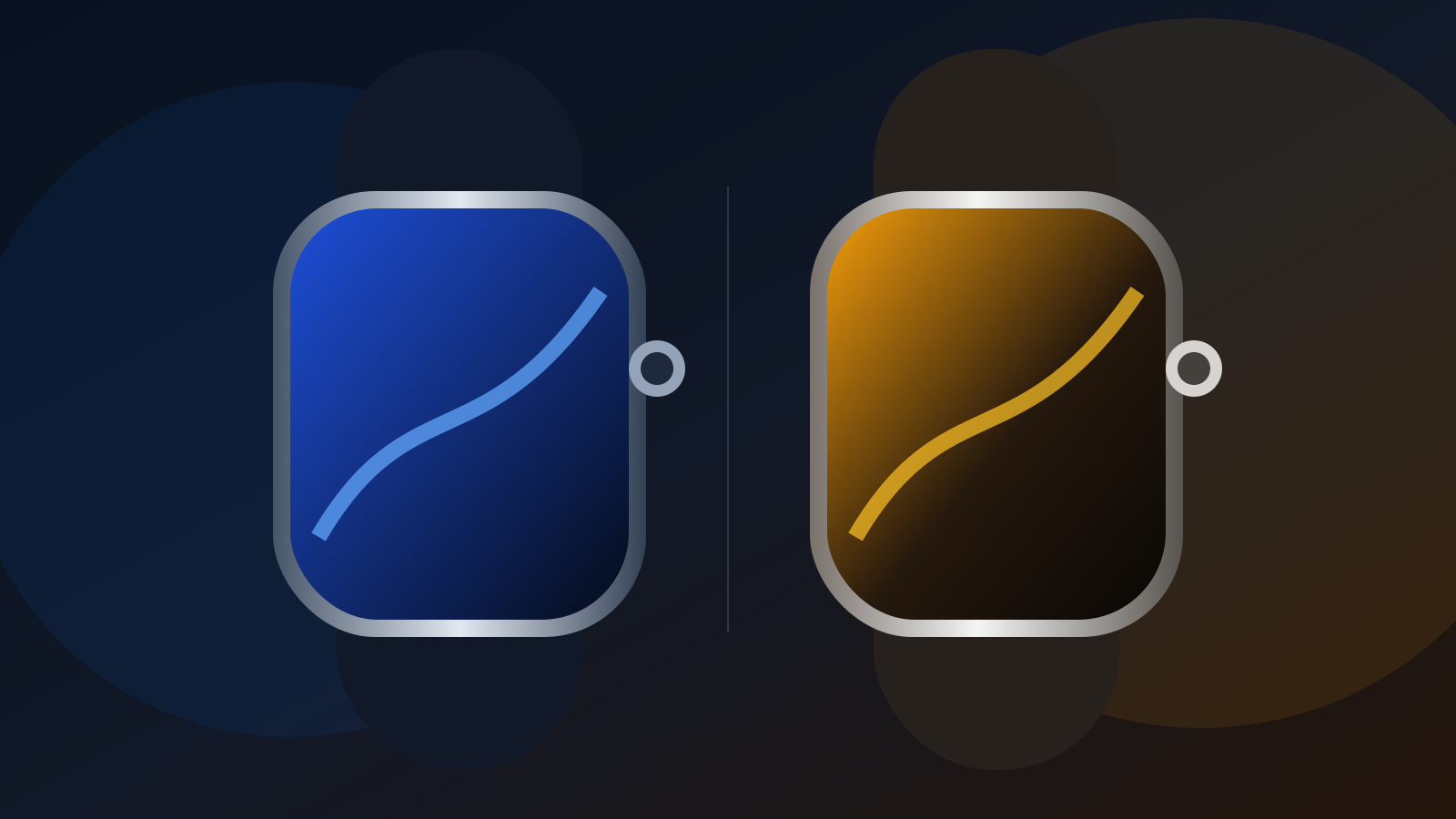
Post-launch evidence notice: Apple Watch Series 12 is official and starts at $399 in the United States, with availability beginning September 18, 2026. FlawCheck has not independently tested retail battery life, sensor accuracy, charging, durability or Audio Intelligence, so both watches remain not scored in this comparison.
The Apple Watch Series 12 has real upgrades. It introduces the S11 chip, a redesigned Health Sensing System, much more frequent background heart-rate and HRV readings, faster charging, Audio Intelligence and new ceramic finishes.
But the most important downside is easy to miss: Apple still rates Series 12 for up to 24 hours of normal use, the same headline rating as Series 11. For most current owners, this is a feature upgrade rather than a charging-routine revolution.
The downside-first verdict is therefore simple:
- Already own Series 11: keep it unless the new health sensing or faster charging solves a problem you repeatedly experience.
- Buying your first Apple Watch: Series 12 offers the newest platform, but compare its $399 entry price with discounted Series 11 inventory.
- Expecting multi-day battery life: neither standard Series model is designed around that priority.
- Interested mainly in AI features: check device, language, region and release-timing requirements before buying.
Quick comparison
| Decision point | Apple Watch Series 12 | Apple Watch Series 11 | Downside-first read |
|---|---|---|---|
| Product status | Official; available September 18 | Shipping previous generation | No rumor premium remains |
| US starting price | $399 | Originally $399; retail discounts vary | Compare live prices, not launch MSRP |
| Processor | S11 | S10 | A newer chip matters when it enables useful features |
| Case sizes | 42mm and 46mm | 42mm and 46mm | Familiar sizing reduces accessory uncertainty |
| Normal-use battery | Up to 24 hours | Up to 24 hours | No headline improvement |
| Low Power Mode | Up to 38 hours | Up to 38 hours | Still not a multi-day default |
| Fast charging | 15 minutes for up to 12 additional hours | 15 minutes for up to 8 hours | Series 12 improves recovery from a low battery |
| Health sensing | Redesigned sensors; high-frequency tracking | Established sensor platform | New data needs accuracy and usefulness evidence |
| AI features | Siri AI and Audio Intelligence, with limits | More limited hardware support | Availability fine print matters |
| FlawCheck score | Not scored | Not scored | Approved evidence gate remains active |
1. The battery headline did not move
Apple rates both watches for up to 24 hours of normal use and 38 hours in Low Power Mode. That is the single most important fact for owners hoping Series 12 would remove daily or near-daily charging.
Series 12 does improve two narrower areas. Apple rates it for longer outdoor workout use, and a 15-minute fast charge can provide up to 12 additional hours instead of the Series 11 claim of up to eight.
That faster recovery can be valuable if you forget to charge before sleep or a workout. It does not automatically create a different ownership routine. Independent mixed-use testing should still measure:
- Always-On display use.
- GPS workout drain.
- Cellular drain away from an iPhone.
- Overnight sleep tracking.
- High-brightness outdoor use.
- Charging time across the full battery range.
- Differences between 42mm and 46mm cases.
Upgrade threshold: the improvement should prevent a real interruption, not merely leave a higher percentage at bedtime.
2. The redesigned health system is the strongest hardware reason to upgrade
Series 12 adds redesigned optical and electrical sensors. Apple says background heart-rate readings can occur every five seconds and HRV measurements as often as every five minutes—far more frequently than Series 11.
More data can improve trend visibility, readiness estimates and recovery context. It can also create more numbers without automatically improving decisions.
Before treating the new sensor system as essential, buyers should ask:
- Does the specific metric change training, recovery or medical follow-up?
- Is the feature available in their country?
- Does it require a compatible iPhone or later software release?
- Has accuracy been independently compared with Series 11 and reference devices?
- Will more frequent sensing affect real-world battery life?
Apple’s claims establish the feature set. They do not replace independent accuracy and false-alert testing.
3. S11 matters mainly because of what it enables
A smartwatch chip upgrade is easy to overvalue. Notifications, timers, workouts, Apple Pay and basic navigation were already responsive on Series 11.
The S11 earns its value through new capabilities: high-frequency sensing, Audio Intelligence, on-device processing and potential efficiency under specific workloads. Peak speed alone is not a strong reason to replace a one-year-old watch.
Current owners should identify one S11-dependent feature they will actually use. If none exists, the newer chip is mostly support runway and future potential.
4. Audio Intelligence has launch-day fine print
Series 12 introduces features such as Siri Recap, Live Rewind and Sound Recognition. These are unusual and potentially useful, especially for accessibility and remembering missed conversation details.
They are not all equally available on day one. Apple says some Audio Intelligence features arrive in beta later in 2026, Siri AI initially rolls out in English, and certain functions require an Apple Intelligence-capable iPhone.
That creates four buyer risks:
- A promoted feature may arrive after the hardware.
- Beta behavior may change.
- Language or region support may exclude some buyers.
- The paired iPhone requirement may add an unstated upgrade cost.
Buy the watch for functions available to your actual setup, not for a keynote promise detached from its requirements.
5. Twenty-four-hour battery and always-on intelligence pull in opposite directions
Series 12 performs more frequent background sensing and adds microphone-based intelligence features while retaining the same official normal-use battery rating.
Apple describes privacy protections for Audio Intelligence, including local and secure processing behavior. Buyers should still evaluate practical controls, battery impact, when listening features are active and whether the usefulness justifies enabling them.
This is not evidence that the feature is unsafe or inefficient. It is a reason to wait for real-world tests before assuming the new intelligence layer is free in battery, attention or setup complexity.
6. Ceramic Shield 2 and ceramic cases do not eliminate repair risk
Aluminum Series 12 models receive Ceramic Shield 2, which Apple says is tougher than the previous Ion-X cover. Apple also brings back premium ceramic cases alongside aluminum and titanium.
A tougher cover can reduce one failure risk, but it does not make the watch immune to impact, edge damage, water-related exclusions or expensive service. Premium materials also raise the amount of money tied up in a device with a small battery that will age.
Buyers considering the $899 ceramic starting tier should compare that premium with:
- AppleCare and service costs.
- Expected ownership duration.
- Battery-service economics.
- Resale demand for the finish.
- Whether appearance changes function.
Material prestige is not the same as ownership value.
7. Series 11 may now be the smarter value purchase
Series 12 keeps the $399 aluminum starting price. Series 11 becomes more interesting when retailers discount it far enough to compensate for its slower charging, older chip and less capable sensor system.
The value equation is:
Series 12 price − Series 11 sale price = cost of the new differences
A modest discount may not justify giving up the longer support runway and new sensing hardware. A large discount can make Series 11 the lower-risk choice for notifications, workouts, sleep tracking, Apple Pay and safety features.
Check return policy, warranty, cellular premium, case size, battery condition on used units and whether the features you need are regionally available.
Who should choose Series 12?
Choose Series 12 when at least one of these is true:
- High-frequency heart-rate or HRV tracking directly supports your health or training workflow.
- Faster charging fixes a recurring sleep-tracking or workout problem.
- You need a Series 12-exclusive accessibility or Audio Intelligence capability and meet its requirements.
- You are buying new and the Series 11 discount is too small.
- You plan to keep the watch long enough to value the newer support runway.
Who should keep or buy Series 11?
Keep or buy Series 11 when:
- Its battery already covers your routine.
- You do not need the new sensing frequency.
- A retailer offers a meaningful discount.
- You prefer mature hardware and software behavior.
- Your main tasks are notifications, workouts, sleep, payments and safety features already supported.
Replacing a one-year-old watch remains the weakest-value path unless Series 12 solves a named limitation.
Evidence-gated comparison status
| Area | Series 12 | Series 11 | Evidence status |
|---|---|---|---|
| Official specifications | Confirmed | Confirmed | High |
| Mixed-use battery | Independent comparison needed | Mature but configuration-dependent | Not scored |
| Sensor accuracy | Independent comparison needed | Existing evidence varies by use | Not scored |
| Charging benefit | Official claims available | Official claims available | Real-world test needed |
| AI usefulness | Compatibility and beta limits apply | Limited access | Long-term value unknown |
| Durability | New materials need ownership evidence | More mature hardware | No numerical score |
| Overall buying score | Not scored | Not scored | Approved evidence set incomplete |
| Downside Score | Not scored | Not scored | Uncertainty is not converted into a score |
Final recommendation
Most Series 11 owners should keep their watch. Series 12 improves health sensing, charging and intelligence features, but it does not change the official 24-hour normal-use battery claim. A one-generation upgrade only makes sense when one of the new capabilities addresses a recurring problem.
New buyers should compare the real price gap. Series 12 is the better long-run platform at similar prices. Series 11 becomes the better value only when its discount is large enough and its existing feature set already matches the buyer’s needs.
For the rest of Apple’s launch, use the iPhone 18 upgrade guide before replacing a recent phone, read the iPhone 18 Pro downside review, or examine the much higher first-generation risk in the iPhone Duo analysis.
Sources and disclosure
Official Series 12 features, case sizes, battery claims, charging, health sensing, S11, availability and feature limitations were checked against Apple Watch Series 12 and Apple’s Watch comparison. Series 11 specifications were checked against Apple Watch Series 11 technical specifications.
FlawCheck has not tested a retail Series 12. Official specifications are treated as product claims; battery endurance, sensor accuracy, durability and long-term software value remain evidence-gated.