Evidence notice: This is a research-based comparison, not a matched hands-on test. Samsung specifications and Samsung US prices were checked on September 8, 2026. FlawCheck does not assign numeric comparison scores for performance, endurance, cameras or thermals until matched retail-unit evidence is sufficient.
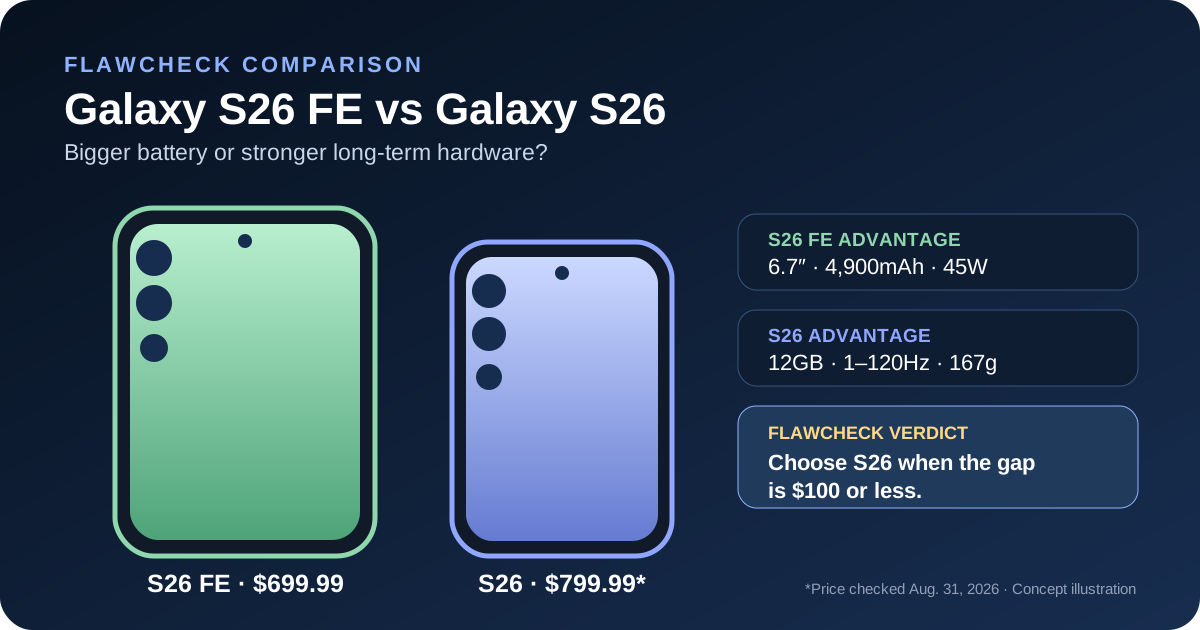
The Samsung Galaxy S26 FE appears to offer the obvious bargain. Its US starting price is $699.99, it has a large 6.7-inch AMOLED display, a 4,900mAh battery, 45W charging, a real 3x telephoto camera and seven years of software support. The regular Galaxy S26 costs more and gives you a smaller 6.3-inch screen and 4,300mAh battery.
That summary hides the decision.
Samsung’s current US store pricing places the 256GB Galaxy S26 at $799.99, while the 256GB Galaxy S26 FE is $799.99 and the 128GB FE starts at $699.99. Promotions can change quickly, which is why the meaningful comparison is the final equal-storage checkout gap rather than the headline starting price. When the S26 is around $100 more than an equal-storage FE, the S26 adds 12GB RAM instead of 8GB, a 1–120Hz display instead of 60/120Hz switching, a higher 2,600-nit brightness claim, a 10MP rather than 8MP telephoto, newer flagship processing and a body that is 26g lighter.
Our short verdict: buy the Galaxy S26 when the final, equal-storage price gap is $100 or less. Buy the S26 FE when you specifically want the larger display and battery, and it saves at least roughly $150 after realistic discounts.
For the FE’s complete compromise list, read our Samsung Galaxy S26 FE review. This comparison answers the narrower purchase question: whether saving money on the FE is worth the hardware you give up. Buyers whose budget stops below the FE should compare the Galaxy S26 FE with the Galaxy A57 before stretching to a flagship badge. If you already own last year’s Fan Edition, our S26 FE vs S25 FE upgrade verdict addresses the more relevant question.
Galaxy S26 FE vs S26 specifications
| Specification | Galaxy S26 FE | Galaxy S26 | Practical winner |
|---|---|---|---|
| US price checked Sep. 8 | 128GB $699.99; 256GB $799.99 | 256GB shown at $799.99 promotional price | Depends on equal-storage checkout price |
| Display | 6.7-inch FHD+ AMOLED, 60/120Hz, 1,900 nits | 6.3-inch FHD+ AMOLED, 1–120Hz, 2,600 nits | Depends on size; S26 on panel |
| Processor | Exynos 2500, 3nm | Exynos 2600 or Snapdragon 8 Elite Gen 5 for Galaxy, market-dependent | S26 |
| Memory | 8GB | 12GB | S26 |
| Storage | 128/256/512GB, market-dependent | 256/512GB | S26 base; FE offers lower entry |
| Main / ultrawide | 50MP / 12MP | 50MP / 12MP | Tie on headline specs |
| Telephoto | 8MP, 3x optical, OIS | 10MP, 3x optical | S26 |
| Battery | 4,900mAh | 4,300mAh | FE on capacity |
| Wired charging | 45W; adapter sold separately | 25W; adapter and cable sold separately | FE |
| Size | 161.6 × 76.9 × 7.4mm | 149.6 × 71.7 × 7.2mm | Depends on preference |
| Weight | 193g | 167g | S26 |
| Protection | Victus+, aluminum, IP68 | Victus 2, Armor Aluminum, IP68 | S26 |
| Launch software | Android 17 / One UI 9 | Android 16 / One UI 8.5 | FE launches newer |
| Wi-Fi | Wi-Fi 6E | Wi-Fi 7 availability varies | S26 |
Do not read the “practical winner” column as a universal score. A large screen can be more useful than adaptive refresh; a bigger battery can matter more than compactness. The column identifies the stronger component, not the right phone for every person.
1. Price: compare 256GB with 256GB
The FE’s $699.99 headline price is attached to the starting 128GB configuration. The S26 begins at 256GB in the US. Comparing the cheapest FE with a 256GB S26 mixes storage tiers and exaggerates the saving.
The correct calculation is:
S26 final checkout price − equal-storage S26 FE final checkout price
Include tax, required accessories and any carrier-plan cost. Exclude the largest advertised trade-in credit unless your actual device qualifies and you are willing to keep the required plan for the full credit period.
Use these thresholds as a decision tool, not a permanent price claim:
- $0–$100 difference: buy the Galaxy S26 unless you need the larger screen.
- $101–$150 difference: close decision; prioritize size, battery and charging versus performance and portability.
- More than $150 difference: the S26 FE becomes easier to justify.
- More than $200 difference: the FE is likely the stronger value for mainstream use, provided 8GB RAM and 128/256GB storage fit your ownership plan.
Promotions change quickly. Recalculate at checkout rather than trusting a review’s cached price.
2. Display: bigger is not the same as better
Galaxy S26 FE gives you 6.7 inches, matching the screen size of the S26+ rather than the compact S26. That extra area is useful for video, larger text, split-screen work, maps and games. Buyers with vision or dexterity needs may prefer it immediately.
The regular S26 has the stronger display technology. Its adaptive refresh range runs from 1Hz to 120Hz, allowing the panel to reduce refresh more aggressively when content is static. The FE switches between 60Hz and 120Hz. Samsung also claims peak brightness of 2,600 nits for S26 versus 1,900 nits for S26 FE.
Peak figures are measured under manufacturer-defined conditions and do not guarantee that the entire panel maintains that level. Even so, the gap supports a clear conclusion: the FE is the larger canvas; the S26 is the more advanced panel.
Choose the FE if display area is the priority. Choose S26 if outdoor visibility, adaptive refresh and compactness matter more.
3. Performance and memory: 12GB matters more than a benchmark headline
S26 FE uses Samsung’s 3nm Exynos 2500 with 8GB RAM. Galaxy S26 uses Exynos 2600 or Snapdragon 8 Elite Gen 5 for Galaxy, depending on device and market, paired with 12GB RAM.
FlawCheck has not run matched thermal or gaming tests. We will not convert chip names into invented frame rates. Samsung says the S26’s redesigned vapor chamber improves heat dissipation, but sustained performance must be verified on the exact regional model.
The RAM difference is easier to interpret. Eight gigabytes is adequate for ordinary Android use today. Twelve gigabytes provides more room for multitasking, camera processing and future on-device AI during a long support window. Neither amount guarantees seven years of smooth performance, but 12GB is the more comfortable starting point.
This is one of the strongest reasons to pay $100 more. A processor advantage may be invisible in messaging; memory pressure can become visible when apps reload, heavy games update or future software grows.
4. Cameras: similar layout, meaningful small differences
Both phones use a 50MP main camera, 12MP ultrawide and 3x optical telephoto layout. Both have a 12MP front camera. That makes the FE look nearly identical on a store comparison card.
The regular S26 has a 10MP telephoto, while the FE uses 8MP. Two megapixels do not guarantee better photographs, but the S26 begins with more telephoto resolution and a newer processing platform. Samsung also applies AI ISP and newer S26-series processing features across the flagship line.
The questions that specifications cannot answer include shutter lag, moving-subject consistency, skin tones, low-light noise, lens transitions, video heat and usable detail beyond 3x. Wait for matched retail-unit samples if camera quality is the deciding factor.
Our provisional judgment:
- Main camera in good light: likely close.
- Ultrawide: likely close on headline hardware.
- Telephoto: advantage S26.
- Processing and sustained video: likely S26 advantage, pending testing.
- Value for casual photography: FE can still be sufficient.
Do not pay for the S26 expecting an Ultra-class camera. It remains the base flagship, not the S26 Ultra.
5. Battery and charging: FE wins hardware, S26 claims similar runtime
S26 FE has a 4,900mAh typical battery and supports 45W wired charging. S26 has 4,300mAh and 25W charging. On capacity and charging specification, the FE wins clearly.
Samsung quotes up to 29 hours of video playback for the FE and up to 30 hours for S26. These figures show why capacity cannot be read alone: screen area, refresh behavior, processor efficiency, modem and test settings all affect runtime. They do not prove that the smaller battery lasts longer in mixed use.
The FE is the safer hardware choice for buyers who want a large battery and faster top-ups. The S26 may compensate through its smaller, more adaptive display and newer platform. Only a matched test covering Wi-Fi, 5G, camera, standby and high brightness can establish the real winner.
Both omit the ideal charging experience. The FE’s 45W adapter is sold separately; Samsung says the S26’s power adapter and data cable are sold separately. Budget for a compatible charger if your existing one cannot deliver the advertised mode.
6. Size and comfort: the 26g difference is not minor
The FE measures 76.9mm wide and weighs 193g. The S26 is 71.7mm wide and 167g. Five millimeters of width changes thumb reach, while 26g becomes noticeable during reading, navigation and one-handed photography.
The FE is not excessively heavy for a 6.7-inch phone, but it is not compact. A protective case increases both width and weight. If you use a phone one-handed, keep it in small pockets or experience hand fatigue, S26 has a major everyday advantage that benchmark tables miss.
The FE’s benefit is equally physical: text, controls and video are larger. Choose based on how you hold and use a phone, not the assumption that more screen is always an upgrade.
7. Durability and five-year ownership
Both devices carry IP68 ratings under Samsung’s stated laboratory conditions. Water resistance is not permanent and may diminish with wear or repair. S26 uses Gorilla Glass Victus 2 and Armor Aluminum; S26 FE uses Victus+ and an aluminum alloy frame.
Both receive a long support runway, but software support is only one part of longevity. Memory, storage, battery replacement, display repair and local parts access determine whether keeping the phone remains economical.
The S26 has more memory and starts at 256GB, giving it stronger long-term headroom. The FE has the larger battery and launches with newer Android 17 / One UI 9 software. A seven-year promise does not mean a worn battery will replace itself or that every repair will be affordable.
Our best phones for long-term ownership guide explains how to evaluate battery service, repair access and total five-year cost instead of ranking phones by update years alone.
Eight downsides to understand before choosing
Galaxy S26 FE downsides
- The equal-storage saving may be smaller than the headline suggests.
- 8GB RAM creates less seven-year headroom than S26’s 12GB.
- Its display is limited to 60/120Hz switching and a lower brightness claim.
- The 193g, 76.9mm-wide body is harder to use one-handed.
- The 8MP telephoto is modest at nearly $700.
- 128GB base storage can push long-term owners toward a costlier tier.
Galaxy S26 downsides
- The 4,300mAh battery is materially smaller, even if Samsung’s video claim is competitive.
- 25W wired charging is conservative and still requires separate charging hardware.
These are trade-offs, not defects. The FE deliberately exchanges compact flagship components for size and a lower price. The S26 exchanges screen and battery capacity for portability and stronger internals.
Which one should you buy?
Buy Galaxy S26 FE if:
- You want a 6.7-inch display and do not want to pay for S26+.
- The equal-storage FE is at least $150 cheaper than S26.
- Battery capacity and 45W charging matter more than one-handed comfort.
- Your workload is mainstream and 8GB RAM is acceptable.
- You are upgrading from an older FE and want long software support.
Buy Galaxy S26 if:
- The final price gap is $100 or less.
- You plan to keep the phone for five years and value 12GB RAM.
- You want a light, genuinely compact Android flagship.
- Gaming, multitasking or sustained performance matters.
- You use telephoto frequently and want the stronger starting hardware.
- Outdoor brightness and adaptive refresh matter more than screen size.
Consider an alternative if neither fits
Buyers focused on computational photography should compare the Google Pixel 11 Pro review. Buyers who prioritize user-replaceable parts over IP68 and flagship performance should read our Fairphone Gen 6+ review. If you want the FE’s 6.7-inch size with the S26’s 12GB RAM and more advanced display, compare the Galaxy S26+—but calculate whether its higher price solves enough problems to justify itself.
Final verdict
The Galaxy S26 FE is cheaper, larger and faster to charge. Those are real advantages. It is not a discounted Galaxy S26 with every flagship component intact.
At a $100 equal-storage gap, the regular Galaxy S26 wins. Its 12GB RAM, adaptive display, brighter panel, better telephoto starting point, stronger processing platform and 167g body are worth more than the saving for most long-term buyers. The FE wins when its large screen is the feature you actually want or when promotions widen the gap beyond roughly $150.
Do not choose by family name. Choose by final price, storage, hand comfort and the limitation you would notice every day.
Sources and methodology
Primary specifications and policy claims were checked against Samsung’s Galaxy S26 FE announcement, Samsung’s Galaxy S26 series announcement, the Samsung US Galaxy S26 FE page and the Samsung US Galaxy S26 page. Samsung US pricing was checked September 8, 2026.
FlawCheck has not physically tested these phones side by side. This comparison remains not scored until matched battery, camera, thermal and sustained-performance evidence is sufficient. Read our editorial methodology, editorial policy and corrections policy.