Quick verdict: what does PWM Hz tell you?
A phone can advertise high-frequency PWM dimming and still leave a key question unanswered: what does its light output actually do at the brightness you use? A frequency in hertz tells you how often a repeated change occurs. It does not, by itself, show how large the change is, what the waveform looks like, or whether the phone switches dimming methods when you lower the brightness. A screen that feels fine outdoors may behave differently when you read in bed; that observation alone cannot identify why it feels different.
The practical answer: look for measurements across several brightness levels, including your typical low-light setting. Compare the frequency with the light-output waveform and modulation, check the exact model and display mode, and try the phone yourself when possible. No single PWM number is a universal comfort or health score. The U.S. Department of Energy’s flicker measurement report distinguishes frequency, percent flicker and flicker index, and explains why waveform shape matters. Its subject is lighting, so its measurement concepts are useful here without treating its lighting criteria as a phone-safety certification. DOE: Characterizing Photometric Flicker
Evidence status: This is a research-based guide. FlawCheck has not measured the screens of every phone discussed. Manufacturer specifications describe claimed features; a model-specific instrument test describes one tested unit under stated conditions; neither guarantees how another person will experience a screen.
How does PWM dimming work on a phone?
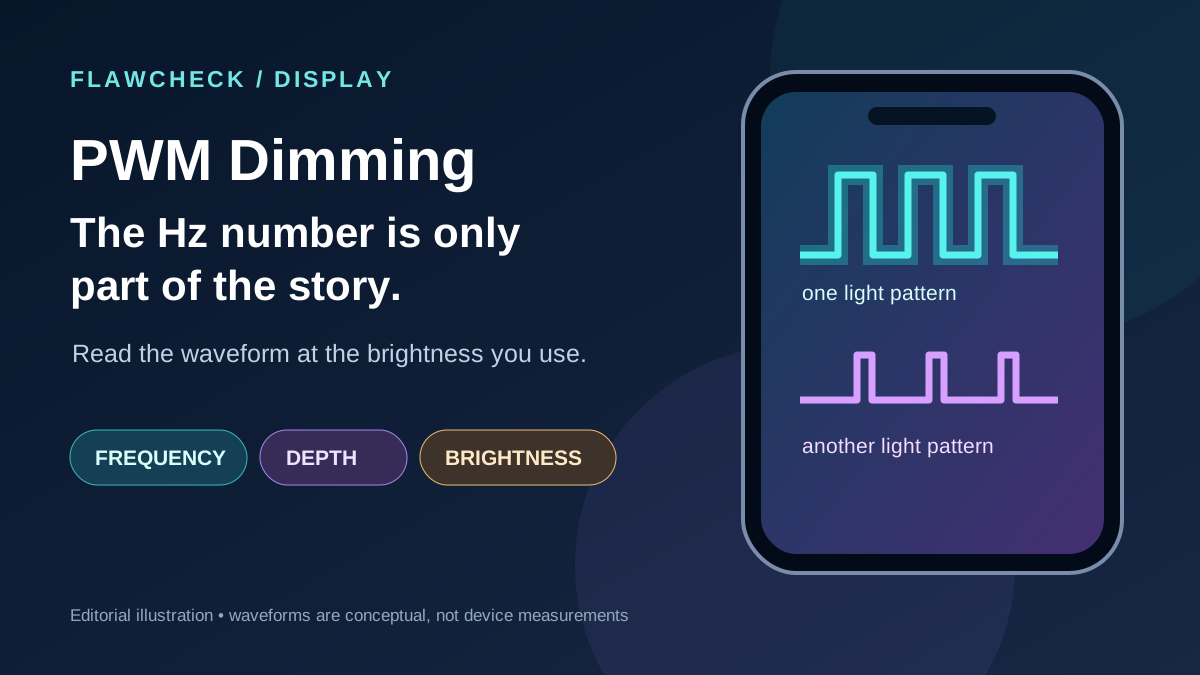
Pulse-width modulation, or PWM, controls average light output by changing the portion of a repeating cycle during which the pixels emit light. Think of a cycle with an “on” period and a darker or “off” period: shortening the on period reduces average brightness. In an AMOLED technical paper presented through the Society for Information Display (SID), researchers contrast this time-based control with DC dimming, which adjusts the current through OLED pixels. SID: AMOLED DC dimming and PWM comparison
That description is a simplified model, not a claim that every phone has a perfect square wave or that every pixel turns completely black each cycle. Real displays can have more complicated waveforms and additional light-output variations. A manufacturer may also use different methods at different brightness levels. Xiaomi, for example, describes the Xiaomi 14T Pro and POCO X6 Pro as using DC dimming at higher brightness and high-frequency PWM at lower brightness. This is evidence for those named models, not a rule for all OLED phones. Xiaomi 14T Pro support · POCO X6 Pro support
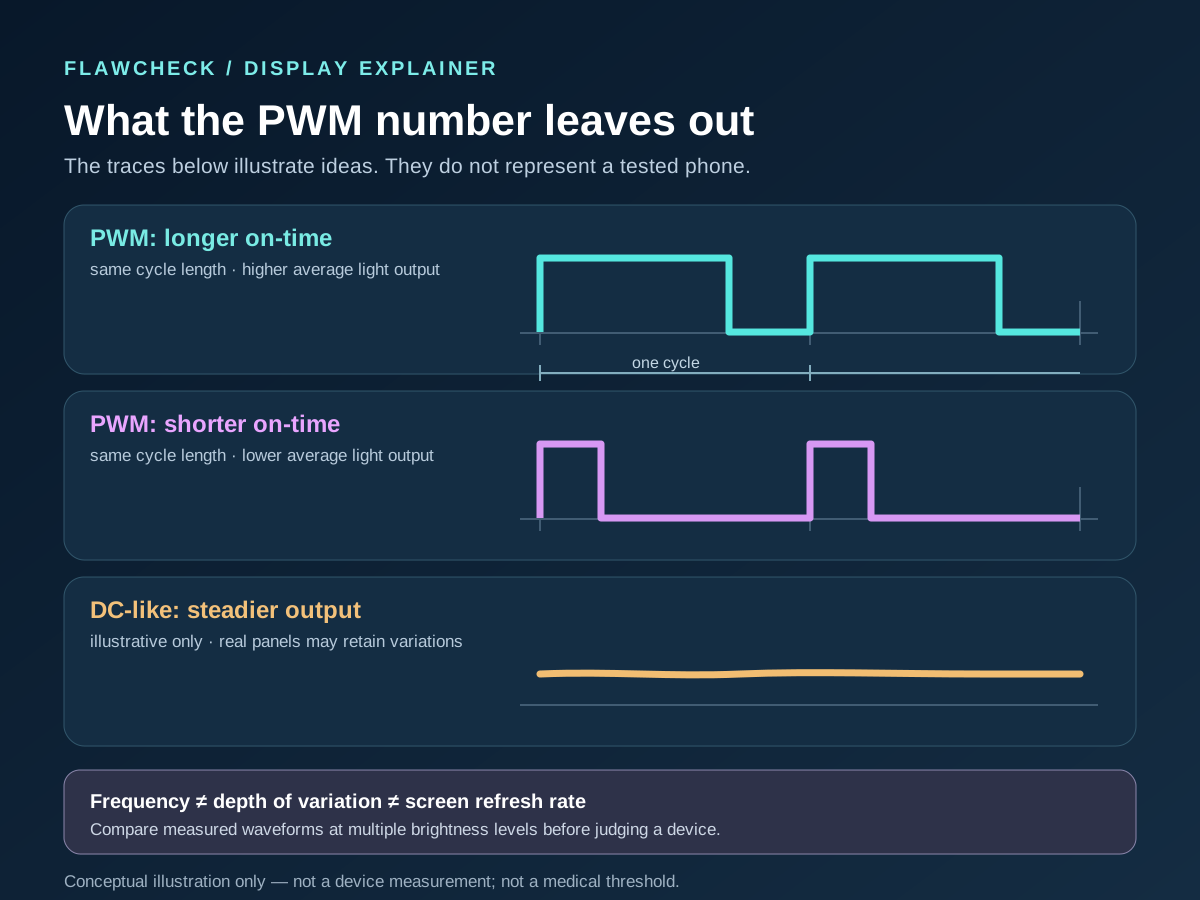
Conceptual illustration only. Pulse widths, shape and amplitudes are not measured device data; the DC-like trace does not promise perfectly constant output.
Downside to check: The buyer’s downside is that a specification such as “2,160Hz PWM” may say little about a screen at the brightness where you actually notice discomfort unless the accompanying measurement shows what happens there. Discomfort can have more than one cause; the timing is a reason to investigate, not a diagnosis. Do not assume that an LCD is automatically free of light modulation, either: its backlight design has to be checked on the specific device. Our phone display technologies guide explains where LCD and OLED differ; this guide focuses on how the light changes over time.
PWM Hz is not the same as 60Hz or 120Hz refresh rate
Refresh rate describes how often the display can update its image. PWM frequency describes a repeated change in emitted light associated with dimming. A phone may have a 120Hz refresh setting and a separate PWM figure in the thousands of hertz. Neither number tells you the other, and a 120Hz display does not make an app render at 120 frames per second.
That distinction helps keep two common complaints apart. If scrolling feels uneven, look at app frame rate, frame pacing and refresh behavior in our 60Hz versus 120Hz phone display guide. If the issue is discomfort at a particular brightness or repeated bands in a camera recording, investigate temporal light output. The two behaviors may coexist; the symptom alone does not identify a cause.
PWM, DC-like and hybrid dimming: what changes?
| Method or label | Basic idea | What the label leaves unanswered |
|---|---|---|
| PWM | Alters the time pattern of emitted light to change average brightness. | Frequency, modulation, waveform and the brightness range in which it operates. |
| DC or DC-like OLED dimming | Changes pixel-drive behavior so brightness can be reduced with less reliance on the advertised PWM pattern. | Whether other temporal variations remain, and whether low-gray uniformity or color changes on this implementation. |
| Hybrid dimming | Uses different dimming behavior in different brightness ranges. | The transition point and waveform on either side of it. |
“DC-like” is a useful description when a phone maker or reviewer does not establish perfectly constant light output. It should not be read as “zero flicker” without a measurement. Nor does PWM automatically mean a display will be uncomfortable for every user.
There is an engineering reason for mixed approaches. The SID AMOLED study describes a low-brightness uniformity problem that can arise with full DC dimming and a method for improving it. The result is specific to the panel design studied; it does not prove that every DC-mode phone has visible blotches. Conversely, the study is not proof that PWM is preferable for every viewer. SID: AMOLED DC dimming and low-gray uniformity
Why a larger PWM number may not settle the question
Frequency is one part of a waveform. Modulation describes how much the measured light output varies, while the waveform and duty cycle describe its pattern over time. The DOE report notes that percent flicker and flicker index describe different aspects of a waveform, and that comparing such metrics without accounting for frequency has limitations. This framework is more informative than calling one number “eye safe.” DOE: Characterizing Photometric Flicker, metrics section
A real-world example illustrates the reading problem without ranking products: in its Xiaomi 17 review, Notebookcheck reports a specified high-frequency dimming feature while its oscilloscope observations also identify a lower-frequency baseline component. Those are observations of the tested unit under the review’s conditions, not a blanket conclusion about every Xiaomi 17 or about a person’s symptoms. Read the plotted trace and brightness series alongside the headline number. Notebookcheck: Xiaomi 17 review and display measurements
Be careful with standards cited in marketing or online arguments. IEEE 1789 concerns modulation of LED lighting and dimming applications. It can help explain why frequency and modulation should be considered together, but this article will not award a phone an IEEE 1789 “safe for eyes” label. IEEE 1789-2015 scope
How to read a phone flicker measurement
Before comparing two reviews, write down their test conditions. A useful report should let you answer these questions:
- Which exact phone and display? Match the model, region if relevant, and the tested software or mode. A named display feature on a different model is not a substitute.
- At what brightness? Look for several measured levels, especially low brightness and the range you normally use. A single maximum-brightness trace cannot describe bedtime reading.
- What was on the screen? Note the test image and screen mode when disclosed. A report that omits them makes replication harder.
- What did the instrument record? Seek a light-output trace or plot, the reported frequency, and some indication of modulation or waveform shape. Separate a dominant low-frequency component from additional faster pulses when the report does so.
- Which options were enabled? An anti-flicker or DC-like setting can change results; so can a different brightness mode. Report a before-and-after comparison only if the reviewer tested both.
- Is it the same measurement method? Different instruments, sampling choices and calculations may produce figures that should not be treated as directly comparable. The DOE’s meter evaluation documents variation among flicker meters, another reason to keep the method attached to a number. DOE: meter comparison
| Specification or result | What it means | What it does not prove |
|---|---|---|
| “High-frequency PWM” | A claimed or measured repetition rate under stated conditions. | Low modulation across all brightness levels or comfort for everyone. |
| “DC dimming” or “anti-flicker” | A selectable or automatic display-drive behavior. | Constant light output in every mode. |
| Percent flicker or modulation depth | The size of light-output variation as calculated by the source. | The complete waveform or a universal comfort threshold. |
| One waveform at 100% brightness | Behavior in that test state. | Behavior at 10% brightness. |
| Bands in a phone-camera video | The camera and display interact in a visible way. | A calibrated PWM frequency, modulation percentage or medical conclusion. |
A slow-motion video or a fast-shutter camera can help you notice a pattern when comparing settings on the same phone. Exposure, shutter behavior and rolling shutter can change the bands. Use the video as a clue to seek an instrument measurement, not as a replacement for one.
A buying check that fits actual use
Best fit: A measured display that remains comfortable in your normal settings matters more than a headline specification.
First, identify the brightness and environment in which you spend the most time with your phone. Search for measurements of the exact model at that range and note whether an optional dimming setting was on. If you can try the device, reproduce your normal reading or scrolling session at your normal settings, including low brightness. If one configuration bothers you, compare available display settings or another phone under similar conditions. Personal comfort is an observation about your use, not proof of a specific medical cause. Persistent or severe symptoms deserve professional evaluation rather than a conclusion drawn from a display specification.
Do not sacrifice every other display requirement for an unverified PWM claim. Check outdoor readability, near-black uniformity, refresh behavior, replacement cost and the screen’s long-term fit. Our guide to outdoor screen dimming covers heat, glare and brightness management, which answer a different question from low-light flicker. The long-term phone buying guide puts display comfort alongside repairs, battery replacement and support when you plan to keep a phone for years.
Verdict
Favor a measured, model-specific account of the full dimming range over a lone Hz figure. The best evidence combines frequency, waveform, modulation and test conditions; the final purchase decision also needs your own experience with the actual screen.