Quick answer: A carrier-locked phone can fit a buyer who has confirmed use on the intended carrier. If you need another carrier, require the carrier to complete the unlock before payment. A clean blacklist result or a seller’s payoff promise does not establish unlock or future eligibility.
A cheaper used iPhone becomes an expensive mistake if it cannot activate on the service you need. The difficult part is often what happens after you pay: the seller stops helping, an unlock request fails, or the affordable plan you wanted will not accept the phone.
Our buying advice: consider a carrier-locked iPhone only when you can confirm it works for your intended service and the savings justify keeping that restriction. If you need another carrier, ask the seller to complete the unlock before you pay.
“You can unlock it later” leaves a critical part of the deal unfinished. Value the phone according to what it can do today.
Is a Carrier-Locked Used iPhone Worth Buying?
It can be, especially if you already want to stay with the permitted carrier. But three things need to line up: the actual phone must be eligible for your line, unresolved ownership or financing questions must be addressed, and the total cost must compare favorably with an otherwise similar unlocked unit.
A carrier lock alone does not tell you the phone is stolen, damaged, or a bad purchase. It tells you there is a restriction to investigate. The discount becomes useful only after you understand what you are accepting.
| Your situation | Our recommendation |
|---|---|
| You want the permitted carrier and have confirmed activation eligibility for your line | Consider it if the unit, total cost, and seller terms suit you |
| The seller promises an easy unlock, but it has not happened | Request a completed unlock before paying if you need another provider |
| You want another carrier, provider, or travel SIM/eSIM | Choose a confirmed unlocked, compatible phone |
| The original carrier or relevant payment status is unclear | Pause the purchase and verify |
| Using the locked phone requires a more expensive plan | Compare the additional service cost over your intended ownership period |
These are editorial buying decisions, not guarantees about an individual phone. A functioning seller’s line is useful evidence of present operation, but does not settle whether your line can activate or whether you can later unlock it.
Locked vs Unlocked iPhones: What Changes?
A carrier lock restricts the providers the iPhone can use. An unlocked phone removes that particular restriction, giving you more freedom to choose service. You still need to confirm that the exact device is accepted by the provider you want.
For a buyer, the practical question is what you might need during ownership. Staying with your existing carrier is one use case. Switching to a cheaper provider, adding a different provider’s eSIM, or handing the phone to someone on another network are different ones. A deal that works for the first case may not fit the others.
Keep these issues separate:
| Issue | Effect | Where to check | Who can resolve it | Limits |
|---|---|---|---|---|
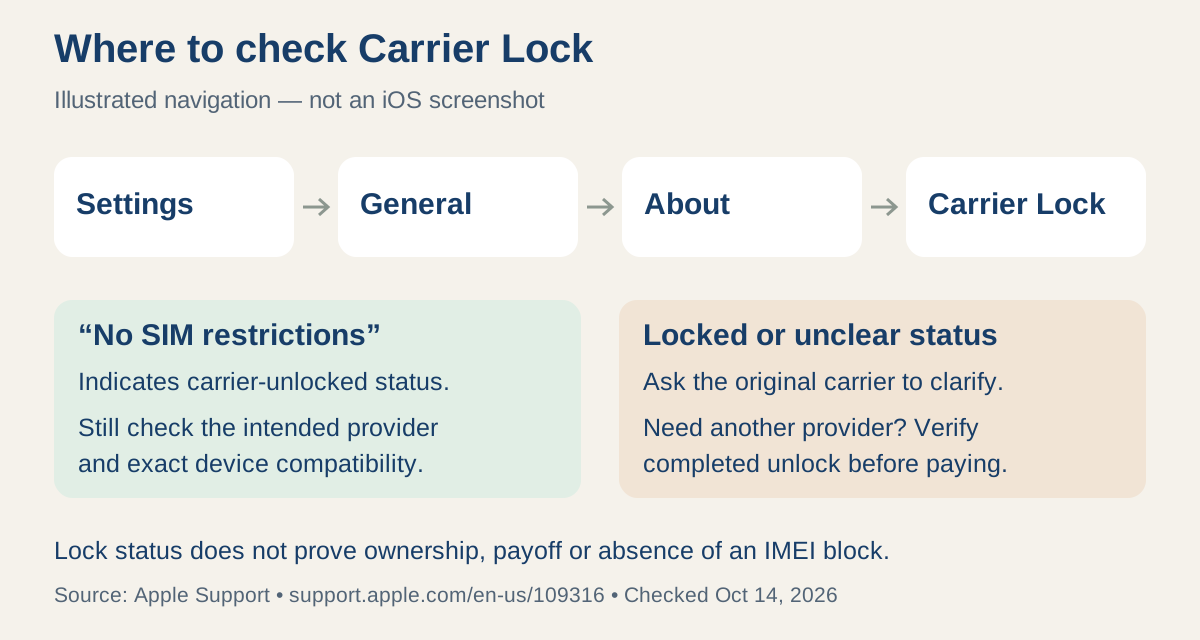
| Carrier lock | Limits which providers can be used. | Settings → General → About → Carrier Lock; confirm with the original carrier. | The carrier applies an eligible unlock. | Does not establish ownership, payoff or acceptance by every provider. |
| Activation Lock | Links the device to the previous owner’s Apple Account through Find My. | Continue setup/activation; investigate any previous-owner credential request. | The previous owner removes the account link; use official support if needed. | An erased phone or Hello screen alone is insufficient. Do not buy while unresolved. |
| IMEI block / blacklist | May prevent cellular access on affected networks. | Official provider checker/support; relevant block-list result. | The reporting carrier or organization must resolve its report. | A clean result is time- and database-specific; it is not payoff proof. |
| Outstanding financing | May prevent unlock or affect eligibility under the applicable policy. | Relevant payoff evidence and carrier/account clarification. | The responsible account holder resolves payment obligations. | Not automatically the same as a global blacklist. |
| SIM PIN | Protects access to a SIM/eSIM with a code. | SIM PIN settings and the SIM provider’s support. | The SIM owner/provider handles PIN/PUK issues. | Does not remove a carrier lock. Do not guess PIN or PUK codes. |
Locks and restrictions
Carrier lock
- Effect
- Limits which providers can be used.
- Where to check
- Settings → General → About → Carrier Lock; confirm with the original carrier.
- Who can resolve it
- The carrier applies an eligible unlock.
- Limits
- Does not establish ownership, payoff or acceptance by every provider.
Activation Lock
- Effect
- Links the device to the previous owner’s Apple Account through Find My.
- Where to check
- Continue setup/activation; investigate any previous-owner credential request.
- Who can resolve it
- The previous owner removes the account link; use official support if needed.
- Limits
- An erased phone or Hello screen alone is insufficient. Do not buy while unresolved.
IMEI block / blacklist
- Effect
- May prevent cellular access on affected networks.
- Where to check
- Official provider checker/support; relevant block-list result.
- Who can resolve it
- The reporting carrier or organization must resolve its report.
- Limits
- A clean result is time- and database-specific; it is not payoff proof.
Outstanding financing
- Effect
- May prevent unlock or affect eligibility under the applicable policy.
- Where to check
- Relevant payoff evidence and carrier/account clarification.
- Who can resolve it
- The responsible account holder resolves payment obligations.
- Limits
- Not automatically the same as a global blacklist.
SIM PIN
- Effect
- Protects access to a SIM/eSIM with a code.
- Where to check
- SIM PIN settings and the SIM provider’s support.
- Who can resolve it
- The SIM owner/provider handles PIN/PUK issues.
- Limits
- Does not remove a carrier lock. Do not guess PIN or PUK codes.
Apple’s Activation Lock documentation describes the account link, while its SIM PIN guide explains SIM protection. Neither is the same thing as a carrier unlock.
Do not buy with unresolved Activation Lock. Apple also explains that an erased phone showing Hello still needs setup and activation before you can test it in its preowned-iPhone guide.
Can You Unlock a Used iPhone After Buying It?
Sometimes, but buying the phone does not automatically make it eligible. According to Apple, the carrier handles a carrier unlock; Apple cannot perform it for you.
The relevant rules may concern payment, activation history, the associated account, or the line requesting the unlock. Buying a secondhand phone does not establish those facts. A seller’s statement that it is paid off should be checked against the requirements that actually apply.
US examples below reflect official pages checked October 14, 2026 (UTC). They summarize ordinary consumer requirements, not every exception. Ask the carrier which policy applies to that device’s purchase and activation history.
| Carrier | Scope | Main requirements | Buyer / process | Source | Checked |
|---|---|---|---|---|---|
| AT&T Wireless | US postpaid | Purchased over 60 days ago; paid in full; not active on another AT&T account; no lost/stolen/fraud report; current customer bill not overdue. | Noncustomers may request if all criteria are met. | AT&T policy | 2026-10-14 |
| AT&T Prepaid | US prepaid | 12 months of paid service; not active on another AT&T account; no lost/stolen/fraud report. | iPhone unlock request; eligibility still required. | AT&T policy | 2026-10-14 |
| T-Mobile | US postpaid | Sold by T-Mobile; at least 40 days active on requesting line; financing/lease paid; account in good standing; no lost/stolen/blocked status. Canceled-account balance must be zero. | May require proof of purchase; buyer’s line history matters. | T-Mobile policy | 2026-10-14 |
| T-Mobile | US prepaid | 365 days from activation, or qualifying refills over $100 per active line and purchase over 14 days ago. Common device/account criteria apply; maximum two unlocks per line in 12 months. | Confirm applicable route and evidence with support. | T-Mobile policy | 2026-10-14 |
| Verizon | US postpaid | Full retail purchase or financing paid in full; lost/stolen report must be cleared. Secure payment needed for immediate unlock; gift-card payment can delay unlock by 35 days. | Automatic when eligible; confirm policy for device history. | Verizon policy | 2026-10-14 |
| Verizon | US prepaid | 365 days of paid and active service; not stolen or fraudulently purchased. | Automatic after eligibility; calendar age alone is insufficient. | Verizon policy | 2026-10-14 |
Carrier unlock requirements
AT&T Wireless
- Scope
- US postpaid
- Main requirements
- Purchased over 60 days ago; paid in full; not active on another AT&T account; no lost/stolen/fraud report; current customer bill not overdue.
- Buyer / process
- Noncustomers may request if all criteria are met.
- Source
- AT&T policy
- Checked
- 2026-10-14
AT&T Prepaid
- Scope
- US prepaid
- Main requirements
- 12 months of paid service; not active on another AT&T account; no lost/stolen/fraud report.
- Buyer / process
- iPhone unlock request; eligibility still required.
- Source
- AT&T policy
- Checked
- 2026-10-14
T-Mobile
- Scope
- US postpaid
- Main requirements
- Sold by T-Mobile; at least 40 days active on requesting line; financing/lease paid; account in good standing; no lost/stolen/blocked status. Canceled-account balance must be zero.
- Buyer / process
- May require proof of purchase; buyer’s line history matters.
- Source
- T-Mobile policy
- Checked
- 2026-10-14
T-Mobile
- Scope
- US prepaid
- Main requirements
- 365 days from activation, or qualifying refills over $100 per active line and purchase over 14 days ago. Common device/account criteria apply; maximum two unlocks per line in 12 months.
- Buyer / process
- Confirm applicable route and evidence with support.
- Source
- T-Mobile policy
- Checked
- 2026-10-14
Verizon
- Scope
- US postpaid
- Main requirements
- Full retail purchase or financing paid in full; lost/stolen report must be cleared. Secure payment needed for immediate unlock; gift-card payment can delay unlock by 35 days.
- Buyer / process
- Automatic when eligible; confirm policy for device history.
- Source
- Verizon policy
- Checked
- 2026-10-14
Verizon
- Scope
- US prepaid
- Main requirements
- 365 days of paid and active service; not stolen or fraudulently purchased.
- Buyer / process
- Automatic after eligibility; calendar age alone is insufficient.
- Source
- Verizon policy
- Checked
- 2026-10-14
Policy pages checked October 14, 2026 (UTC). Confirm the policy applicable to the actual device’s purchase and activation history.
AT&T has a noncustomer request route when all requirements are met. T-Mobile’s requesting-line requirement means model age is not enough. Verizon separates paid-off postpaid devices from prepaid paid-service requirements. The table summarizes these policies; it is not an eligibility decision for your phone.
Unlock promised later? Pause. If your intended provider requires it, request a completed unlock before paying. A request, payoff promise or model’s age does not establish that completion.
For the buyer, the preferred sequence is straightforward: the seller resolves the outstanding requirements, the unlock completes, and you verify the resulting status. Do not structure a purchase around a hoped-for outcome that someone else must deliver later.
Will a Locked iPhone Work With Your Carrier or MVNO?
Start with the provider you intend to pay, not just the network name in the listing. Ask whether the specific phone can activate on your intended line and whether physical SIM or eSIM activation is supported.
An MVNO’s use of a larger carrier’s infrastructure is not sufficient proof of acceptance. Mint Mobile’s BYOP page requires a compatible, unlocked phone. Visible’s BYOD guidance also requires unlocking and an IMEI compatibility check. These examples do not establish the policy of every MVNO; check yours directly.
Treat lock status, network acceptance, and SIM/eSIM support as separate questions. T-Mobile’s BYOD checker distinguishes compatibility from blocked or unknown status and eSIM readiness. An unknown result calls for clarification.
Where practical, test the intended service with Wi-Fi off and confirm calls and mobile data. If a test is unavailable before an online purchase, keep that uncertainty explicit and read the seller’s applicable return terms. Avoid moving your main number just to inspect a phone you may reject.
For travel, distinguish roaming on your existing line from activating a different provider’s local SIM or eSIM. Verizon’s explanation explicitly separates roaming from a carrier lock; other providers’ service and costs still need checking. A carrier lock concerns the latter; it does not itself establish your roaming coverage or costs. Ask the provider about both before planning around the phone.
How Do You Check a Used iPhone Before Paying?
Use this focused sequence alongside our full used iPhone buying checklist. It does not replace battery, repair, or hardware checks. Read our used iPhone battery-health guide when weighing battery disclosure alongside the deal.
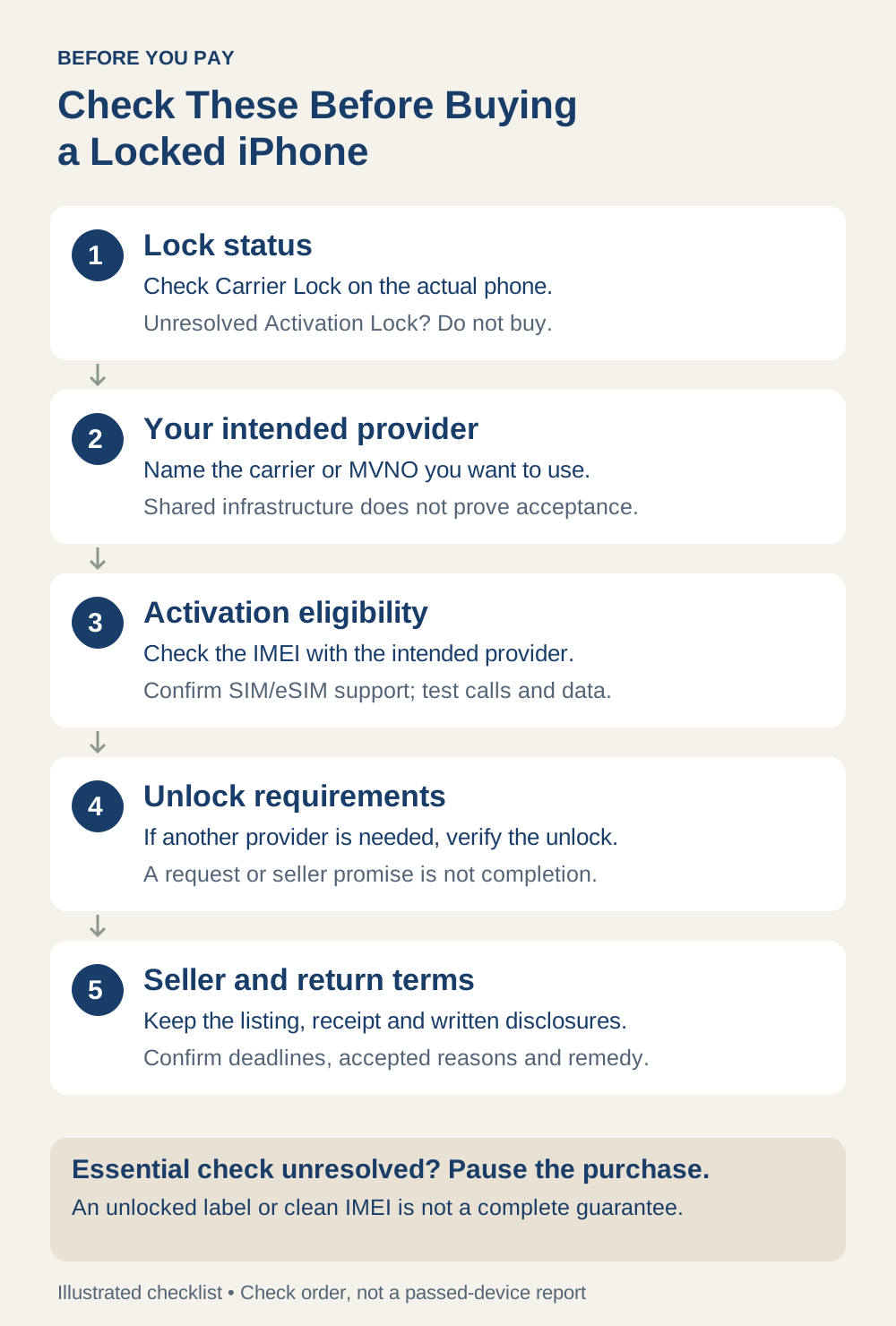
- Confirm the listing and the device. Match the exact model, storage, regional variant, and disclosed carrier restriction. Match the IMEI shown on the actual iPhone to the listing, invoice or transaction record; clarify any mismatch before paying. Identify the actual seller and obtain the applicable return and refund terms.
- Inspect Carrier Lock. Open Settings → General → About. Apple identifies “No SIM restrictions” as the unlocked indicator. If the phone is locked, establish the original carrier and intended use.
- Check the device with your intended provider. Use its official IMEI checker or support. Ask about activation eligibility, not only whether that model is supported.
- Clarify financing and unlock eligibility. Ask for relevant payoff information and carrier confirmation where needed. Keep “not currently blocked” separate from “paid off.”
- Verify completion if an unlock is required. Recheck status and the intended service after the carrier completes the process. A submitted request leaves the outcome unresolved. A changed SIM/eSIM provider still needs carrier-unlock and compatibility checks; eSIM is not a bypass.
- Record the agreement. Keep the listing, disclosures, receipt, and terms. Check an online delivery promptly within the applicable return period.
GSMA’s Device Check terms explain why a clean report has limits: status can change, reporting can be delayed, and a carrier may impose a billing-related block even when the device is absent from the GSMA Block List.
Our IMEI result guide for used iPhones explains how to read clean, blocked and unknown results without confusing them with unlock or payoff status.
This is a reason to verify carefully, not a claim that every financed phone is globally blacklisted. Different checks answer different questions. If a result remains unclear, pause rather than turning it into a pass.
Does the Lower Price Actually Save You Money?
| Factor | Locked used iPhone | Unlocked used iPhone | Buying implication |
|---|---|---|---|
| Purchase price | Assess the actual locked listing; no universal discount assumed. | Use a comparable unit with the same model, storage, condition and terms. | Compare actual checkout costs. |
| Additional service costs | Restriction may constrain plan choice; count only costs you actually incur. | Compare providers that accept the device and meet your needs. | Assess total cost over your intended ownership period. |
| Switching providers | Another provider may require a completed unlock. | Carrier restriction removed; compatibility and activation eligibility still need checking. | Do not value a promised unlock as completed. |
| Travel | Existing-provider roaming has its own coverage and costs; another-provider SIM/eSIM needs checks. | More provider choice, subject to model, SIM/eSIM and service support. | Separate roaming from a local or travel SIM/eSIM. |
| Return terms | Read the actual seller’s terms for a disclosed locked unit. | Read the actual seller’s terms for the delivered unit. | Neither label guarantees a refund or a fixed return window. |
Locked vs unlocked
Purchase price
- Locked used iPhone
- Assess the actual locked listing; no universal discount assumed.
- Unlocked used iPhone
- Use a comparable unit with the same model, storage, condition and terms.
- Buying implication
- Compare actual checkout costs.
Additional service costs
- Locked used iPhone
- Restriction may constrain plan choice; count only costs you actually incur.
- Unlocked used iPhone
- Compare providers that accept the device and meet your needs.
- Buying implication
- Assess total cost over your intended ownership period.
Switching providers
- Locked used iPhone
- Another provider may require a completed unlock.
- Unlocked used iPhone
- Carrier restriction removed; compatibility and activation eligibility still need checking.
- Buying implication
- Do not value a promised unlock as completed.
Travel
- Locked used iPhone
- Existing-provider roaming has its own coverage and costs; another-provider SIM/eSIM needs checks.
- Unlocked used iPhone
- More provider choice, subject to model, SIM/eSIM and service support.
- Buying implication
- Separate roaming from a local or travel SIM/eSIM.
Return terms
- Locked used iPhone
- Read the actual seller’s terms for a disclosed locked unit.
- Unlocked used iPhone
- Read the actual seller’s terms for the delivered unit.
- Buying implication
- Neither label guarantees a refund or a fixed return window.
Compare offers that are otherwise alike. A locked phone with weaker battery disclosure, fewer return options, or less storage is not a clean price comparison with a better unlocked unit. Those differences need their own assessment.
Start with the purchase-price difference, then subtract the additional costs you would incur because of the restriction. Include required service spending, activation charges, and other necessary costs over the period you expect to keep the phone. Count only genuine differences between the two options.
Hypothetical example — these are invented figures for arithmetic, not current listings or plan prices:
| Item | Locked option | Unlocked option |
|---|---|---|
| Purchase price | $240 | $300 |
| Monthly service for your intended use | $40 | $25 |
| Service cost over 12 months | $480 | $300 |
| Combined phone and service cost | $720 | $600 |
The locked option saves $60 on the phone but adds $180 in service spending, leaving it $120 more expensive over this period. Its $15 monthly difference consumes the initial saving after four months. The calculation excludes taxes, fees, repairs, and accessories; include any actual differences when comparing real offers.
If both phones work on the service you already want at the same cost, that particular penalty disappears. Then assess whether the upfront saving is worthwhile given the restriction, seller terms, and your likely needs. There is no evidence here for a universal “20% cheaper means buy” threshold.
Avoid including speculative unlock costs or a promised future resale price as established facts. Compare the deal available now. Our used iPhone guide under $300 covers model choices; this calculation addresses the carrier restriction within a particular offer.
When Should You Walk Away?
Walk away when a required condition remains unresolved and the transaction would leave you carrying that uncertainty. A low price is not a substitute for eligibility.
Typical stop points include an unidentified carrier, an unresolved block, missing clarification about relevant financing, or a seller who requires payment before an unlock you need. Unresolved Activation Lock is a separate reason not to buy.
For an online offer, read exactly what happens if the phone cannot activate on your service. Do not infer that every compatibility problem qualifies for a refund. A disclosed locked phone may be sold on terms that expect the buyer to understand the restriction.
A locked unit can still be reasonable when its permitted service matches your plans, your line’s eligibility is confirmed, and the overall deal suits you. If you expect to change providers or share the device with someone using another network, weigh that future need before choosing the cheaper listing.
For the broader choice between purchase types, see new vs used vs renewed iPhones. Here, our verdict is narrower: buy a locked phone for a confirmed use case, and value an unlock only after it has happened.
Sources and inspection limits
Official carrier policies and Apple guidance are distinguished from our conditional buying recommendations. The recommendations, inspection sequence and cost example are editorial analysis, not device measurements. Carrier/GSMA/MVNO documents describe their own requirements; they do not prove eligibility of a delivered unit.
The policy examples retain their stated observation dates; selected Apple, US carrier and GSMA pages were reviewed October 16, 2026. No delivered-unit test or actual unlock request was performed. Policy applicability, IMEI acceptance and seller remedies require unit-specific confirmation. The price example is hypothetical.