Are Foldable Phones Durable Enough for 5 Years? The Repair Costs Buyers Miss
Foldables may receive years of software updates, but fragile inner screens, hinge wear, and costly repairs can shorten their practical life. See the real five-year risks.
Decision in 30 seconds
What matters most
- ✓ Fold-cycle ratings describe a controlled component test, not a five-year warranty for the complete phone.
- ✓ The flexible inner display, protector, hinge and moving cables add failure and maintenance paths that slab phones do not have.
- ✓ Protection-plan premiums, deductibles, downtime and post-repair resale value belong in the ownership cost.
- ✓ Long software support does not guarantee economical hardware repair in years four or five.
- ✓ Risk-sensitive buyers should obtain five model- and region-specific repair prices before ordering.
How we selected
- Flexible-display, protector, hinge and cable wear paths
- Regional repair prices, parts access and authorized-service availability
- Warranty exclusions and accidental-damage plan terms
- Battery serviceability, software support and depreciation
- Total five-year cost compared with a conventional flagship
Bottom line
A carefully used foldable can last five years, but it remains less predictable than a conventional flagship because one inner-display or hinge repair can become uneconomical after depreciation.
Foldable phones no longer feel like fragile prototypes. Their hinges and frames have improved, several models promise years of software support, and manufacturers advertise tests involving hundreds of thousands of folds. But a phone that still turns on after five years is not necessarily affordable or sensible to keep. The inner protector may lift, the battery may fade, the hinge may stop opening flat, or a damaged display may cost more to replace than the ageing phone is worth.
The short answer: a carefully used foldable phone can potentially last five years, but it remains a higher-risk five-year purchase than a conventional flagship. The greatest risk is not necessarily that the hinge suddenly snaps. It is that one expensive inner-display or hinge repair becomes difficult to justify after the phone has already lost much of its value.
The important distinction is between physical survival and economically sensible ownership.
Five Years Is Possible, but It Is Not Yet Predictable
There is no universal expiration date. Model design, dust, drops, temperature, repair access, and manufacturing variation affect the outcome. Modern foldables are more mature, but still contain more failure points than a conventional phone:
- A flexible inner OLED covered by a relatively soft protective surface.
- A factory-applied protector that bends every time the phone closes.
- A mechanical hinge with gaps and moving components.
- Flexible cables that must continue working through repeated movement.
- Two chassis halves that must stay aligned.
- In many models, a split or dual-cell battery arrangement.
A foldable adds a moving structure and a second, unusually expensive display. The useful question is how much uncertainty and repair cost this model introduces.
Fold-Cycle Ratings Do Not Equal a Five-Year Guarantee
Hinge-cycle numbers sound reassuring because they are easy to convert into years. If a hinge is tested for 200,000 folds, opening it 100 times per day would take about five and a half years to reach that number. A 400,000-fold rating appears to imply more than ten years at the same rate.
HONOR, for example, says the Magic V2 hinge is certified for 400,000 folds and translates that into up to ten years at 100 folds per day. That is useful evidence that the hinge survived a defined repetitive test. It is not a ten-year warranty for the complete phone.
A laboratory test repeats a controlled motion. Real ownership adds variables the arithmetic cannot capture:
- Fine grit or debris near the hinge.
- Drops that slightly deform the frame.
- Pressure from objects trapped between the two halves.
- Hot cars, cold weather, and repeated thermal expansion.
- Uneven one-handed opening and closing.
- Ageing adhesives, seals, cables, and batteries.
- Scratches or dents that later complicate a warranty claim.
Another component may fail before the hinge reaches its test figure. Treat a fold-cycle rating as component-level evidence, not the expected life of the whole device.
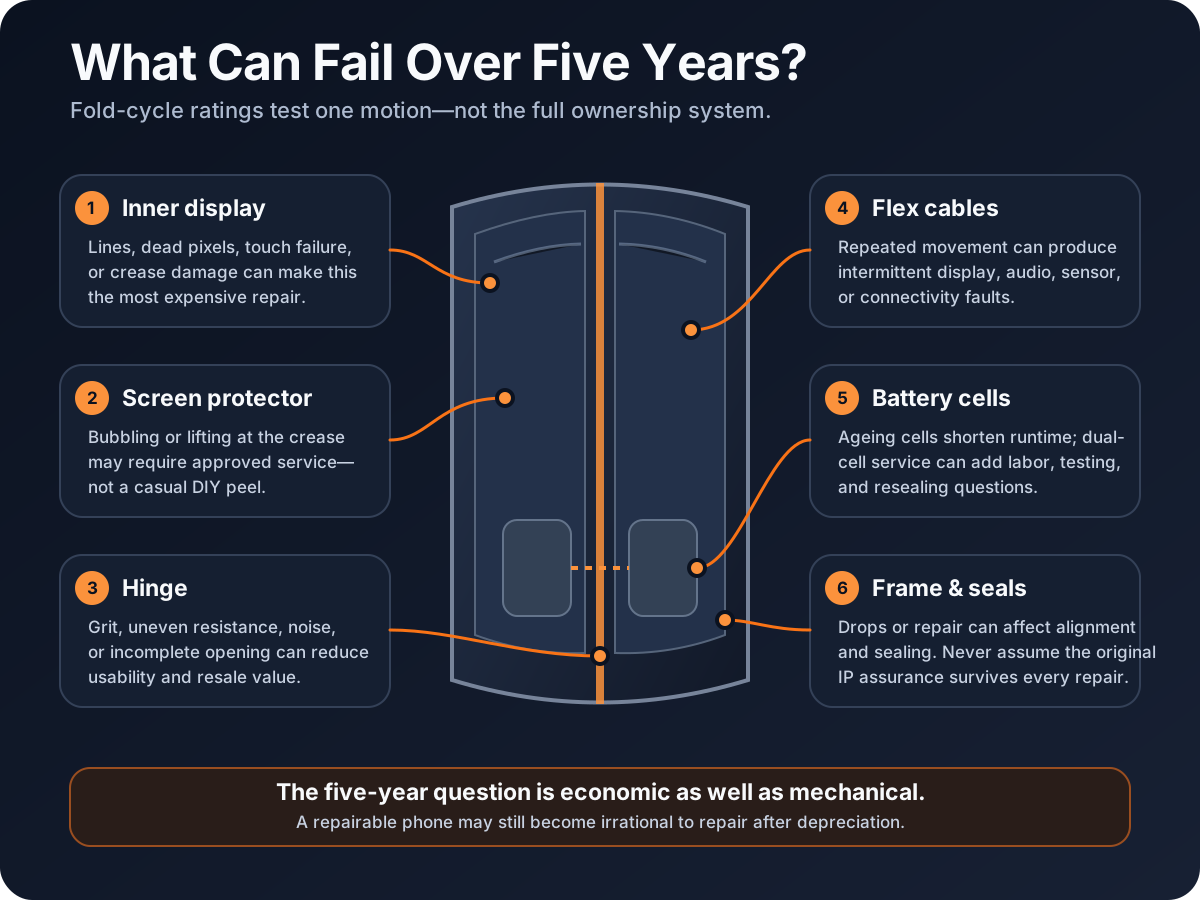
What Can Fail Over Five Years?
| Component | What ageing may look like | Why it matters |
|---|---|---|
| Inner display | Dead pixels, lines, touch failure, cracks near the crease | Often the most expensive major repair |
| Screen protector | Lifting, bubbling, cracking, or separating at the crease | May need professional replacement; ignoring it can worsen the experience |
| Hinge | Noise, increased resistance, looseness, or incomplete opening | Repair may involve extensive disassembly or a larger assembly |
| Flex cables | Intermittent display, audio, sensor, or connectivity problems | Repeated movement makes diagnosis and repair more complex |
| Battery cells | Shorter runtime, imbalance, swelling, or slower charging | A large inner screen makes reduced capacity more noticeable |
| Frame and seals | Misalignment or reduced sealing after impact or repair | Can affect closing, display pressure, and water-resistance confidence |
The inner display remains the expensive vulnerability
The inside screen has to bend, so it cannot be protected in exactly the same way as the rigid cover screen on a normal phone. Many foldables use a multi-layer construction involving flexible OLED, ultra-thin glass, and a polymer protective layer. This makes folding possible, but the surface can still be softer and easier to mark than conventional cover glass.
A scratch does not mean the phone is failing. The financial risk appears when damage reaches the display assembly, which may include the frame, hinge, buttons, or other attached parts depending on the model.
The screen protector is maintenance, not decoration
The factory-applied inner protector should not be treated like an ordinary protector that can always be peeled off and replaced at home. Manufacturers and carriers commonly warn owners not to remove it without checking the correct service procedure.
Samsung offers a one-time protector application service for eligible Galaxy Z devices in some markets during the first year. Terms vary by region, but the service illustrates that the protector is a wear item. If it bubbles or lifts, check the manufacturer’s policy instead of pulling it off or installing an unapproved layer. Our foldable screen-protector peeling guide explains how to separate a replaceable film issue from display warning signs and when to stop folding the phone.
A hinge problem is not always a broken hinge
The more realistic long-term complaint may not be a snapped hinge, but a phone that no longer opens flat, feels gritty, or develops uneven resistance. It may remain usable while losing resale value.
Dust resistance has improved, but water and dust are separate parts of an IP rating. No rating makes a phone immune to fine particles, deformation, or ageing seals.
Five years also means at least one battery decision
Lithium-ion batteries lose capacity with age. Buyers should check whether the battery can be replaced independently, whether both cells are serviced as a set, and what water-resistance assurance applies after opening the device. The same repair-versus-replacement test in our phone battery decision guide applies, but a foldable adds more ageing assemblies to the quote.
The Repair Costs Buyers See—and the Ones They Miss
The quoted repair price is only the visible cost. Five-year ownership also includes plan fees, deductibles, shipping, downtime, follow-on repairs, and the phone’s value afterward.
| Repair event | Visible cost | Frequently missed cost |
|---|---|---|
| Inner-screen replacement | Part and labor | Shipping, diagnostics, downtime, and reduced resale confidence |
| Protector replacement | Protector and application | Travel or mail-in time and repeat replacement after coverage ends |
| Hinge repair | Hinge or larger assembly | Extensive disassembly and possible screen/frame replacement |
| Battery service | Cells and labor | Seal replacement, testing, and loss of the phone during service |
| Insurance or care plan | Monthly or upfront premium | Deductible, enrollment window, exclusions, and coverage end date |
| Out-of-warranty diagnosis | Inspection fee | Paying even when the final repair is rejected |
Published part prices show how high the ceiling can become. In the United States, the genuine Pixel 9 Pro Fold inner-display assembly was listed through iFixit at about $1,199, or roughly $1,207 with tools, when reported in November 2024. It included more than the OLED panel and was a DIY part price—not a universal Google repair quote.
At the more extreme end, Huawei published screen-replacement pricing for the dual-hinged Mate XT that reached 7,999 yuan when the damaged display was returned and 9,799 yuan when it was not. The tri-fold Mate XT is not representative of every book-style foldable, but it demonstrates how quickly the economics deteriorate when a complex display assembly is damaged.
Do not average these examples into a fictional “typical” repair price. Costs vary by model, country, repair channel, plan, and whether the old part is returned.
Warranty Is Not the Same as Accidental-Damage Coverage
A standard warranty normally covers qualifying manufacturing defects, not cracked displays, impact, liquid, debris, or improper handling. Disputes can arise when an owner sees no accident but an inspection finds a dent or other physical evidence. Our IP ratings and water-damage warranty guide explains why a resistance rating is not the same thing as repair coverage.
An extended protection plan can make foldable ownership more predictable, but it should be counted as part of the purchase price. The questions that matter are:
- Is the inner folding screen explicitly covered?
- Is accidental damage covered, or only mechanical failure?
- What is the deductible for screen repair and full-device replacement?
- Are claims unlimited, capped, or limited within a rolling period?
- Can coverage continue for the full planned ownership period?
- Is same-day repair actually available in the buyer’s location?
A low advertised repair fee may apply only while a paid plan remains active. A free first protector replacement may not cover later replacements. Evaluate protection as a five-year expense, not a free first-year bonus.
Software May Outlast the Economically Useful Hardware
Long software support reduces the chance that a functional phone becomes obsolete only because updates stop. It does not guarantee seven affordable years of hardware ownership.
Software support and physical durability answer different questions:
- Software support: Will the phone continue receiving operating-system or security updates?
- Hardware durability: Will the display, hinge, cables, batteries, and frame remain usable?
- Economic durability: If something fails, will repair cost less than the value of keeping the phone?
A foldable can pass the first test and fail the third. By year four, a supported phone may have depreciated enough to make a display repair irrational. “Seven years of updates” is not automatically “a seven-year phone.”
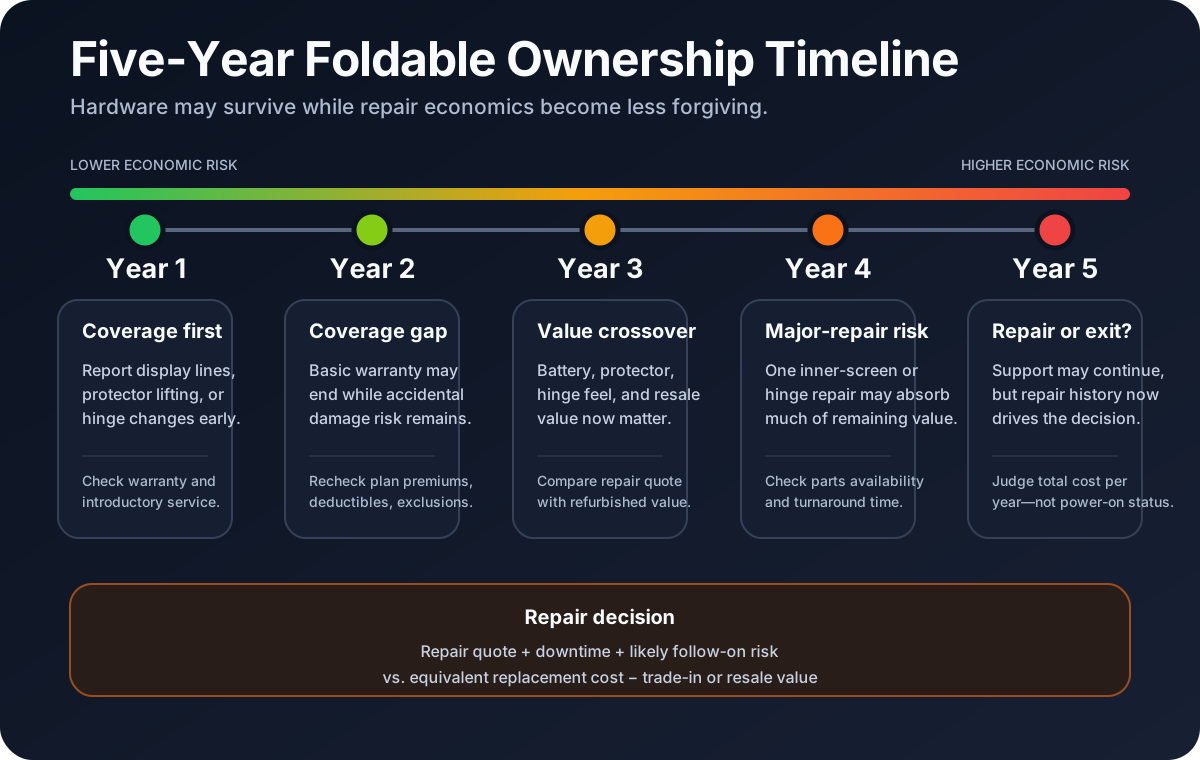
A Realistic Five-Year Ownership Timeline
Year 1: warranty confidence is highest
Address protector lifting, display lines, or hinge changes while the basic warranty and any introductory service benefits remain active.
Year 2: accidental damage becomes the dividing line
Standard coverage may be ending. Compare the remaining protection benefits with premiums and deductibles; frame damage can also complicate later claims.
Year 3: battery and resale value enter the calculation
Battery degradation and protector wear may become noticeable. Compare any major repair quote with a refurbished replacement and current trade-in value.
Year 4: one major repair may end ownership
Software may remain current, but an inner-screen or hinge repair can consume a large share of the phone’s remaining value.
Year 5: survival depends on repair history, not only specifications
A healthy five-year-old foldable may remain useful. If it has already needed one display assembly and now faces another major repair, judge it by total money spent per year—not whether it can still switch on.
Foldable vs. Conventional Flagship Over Five Years
| Five-year consideration | Foldable phone | Conventional flagship |
|---|---|---|
| Moving mechanism | One or more hinges | None in normal use |
| Main-screen surface | Flexible and comparatively soft | Rigid cover glass |
| Number of major displays | Usually two | Usually one |
| Typical case protection | More complex around hinge | Simpler full-perimeter options |
| Major screen-repair exposure | Potentially very high | Usually lower and more predictable |
| Battery ageing | Similar chemistry; design may use split cells | Similar chemistry; often simpler construction |
| Five-year cost predictability | Lower | Higher |
| Unique benefit | Tablet-like area or compact folding body | Simplicity and mature repair ecosystem |
The conventional phone is not indestructible. It is simply the safer choice when the buyer’s highest priority is predictable long-term phone ownership. A foldable must earn its additional risk by providing a benefit the owner uses regularly—such as replacing a small tablet, enabling serious multitasking, or making a full-size phone more pocketable.
Who Should Buy a Foldable With a Five-Year Plan?
A five-year foldable purchase is more reasonable if you:
- Have authorized repair access and clear regional repair prices.
- Include protection-plan premiums in the real purchase price.
- Avoid sand, workshop dust, and loose debris.
- Can tolerate repair downtime.
- Gain meaningful daily value from the folding form factor.
A conventional flagship is still the safer option if you:
- Need five years with minimal intervention.
- Often drop phones or work in dust.
- Cannot absorb a large repair bill.
- Have limited repair access.
- Rarely benefit from unfolding the device.
Five Prices to Check Before You Buy
Before ordering any foldable, ask the manufacturer or authorized service provider for five model-specific numbers:
- The out-of-warranty inner-display repair price.
- The battery-replacement price.
- The protector-replacement price after any free service ends.
- The total protection-plan premium over the period you expect to keep it.
- The deductible for accidental damage or full-device replacement.
Also record the region and date. Repair prices and plan terms change. If the company will not provide a clear inner-screen price, treat that uncertainty as part of the ownership risk.
Final Verdict
Some carefully treated foldables will last five years, but they do not yet offer the predictability of a mature conventional flagship. A phone can pass hundreds of thousands of controlled folds and still face protector wear, battery degradation, seal ageing, or an uneconomical display repair.
If the folding design creates meaningful daily value, that risk may be acceptable with transparent repair pricing and suitable protection. If the priority is five years at the lowest predictable cost, a conventional flagship remains the more defensible choice.
Do not ask only whether the foldable can survive five years. Ask what it will cost you to keep choosing repair over replacement each time something goes wrong.
Related Foldable Risk Checks
- Compare current designs and evidence gaps in our iPhone Duo vs Galaxy Z Fold7 vs Pixel 11 Pro Fold comparison.
- See why first-generation evidence matters in the iPhone Duo foldable-display risk audit.
- If considering an import, add parts, firmware and service access from our Xiaomi 18 Fold review to the durability calculation.
Sources and Verification Notes
- HONOR foldable-phone durability claims
- AT&T guide to foldable construction, care, and durability
- Samsung Galaxy Z screen-protector service
- iFixit Google Pixel Fold repair resources
- Pixel 9 Pro Fold inner-screen part pricing reported by The Verge
- Huawei Mate XT repair pricing reported by The Verge
- Samsung Care+ screen coverage reporting
- Motorola Moto Care overview
Frequently Asked Questions
Direct answers to common buyer concerns and uncertainties.
Can a foldable phone last five years?
Yes, especially with careful handling and proper maintenance. It remains less predictable than a conventional flagship because the flexible display, protector, hinge and repair costs add risk.
How many folds equal five years of use?
At 100 openings per day, five years equals about 182,500 folds. This is not a lifespan guarantee because laboratory tests cannot reproduce every drop, particle, temperature change, ageing seal or battery cycle.
Does a foldable screen protector need replacement?
It may. Lifting or bubbling can develop near the crease. Check the manufacturer's service policy and do not remove it without approved instructions.
Is foldable-phone insurance worth it?
It can be valuable when one covered inner-screen repair would otherwise be expensive. Compare premiums, deductibles, exclusions, claim limits and duration—not only the advertised repair fee.

Written by FlawCheck Editorial Desk
Editorial ResearchFlawCheck's editorial desk is responsible for source review, claim labeling, buyer-risk analysis, publication updates, and corrections. Current articles are research-based unless a documented hands-on method is explicitly provided.
Reviews behind this guide
View All Reviews →
Apple iPhone 18 Pro
"The iPhone 18 Pro is now a confirmed $1,199 flagship with meaningful hardware changes, but launch specifications do not prove that those changes improve ownership enough to justify upgrading. Wait for independent battery, thermal, camera and C2 modem testing if your current phone still works well."
"Starts at $1,199 in the US"
ASUS Vivobook Go 15 OLED Slim Laptop
"A budget-friendly 15.6-inch laptop crippled by non-expandable 8GB soldered memory, an outdated Zen 2 CPU architecture, dim 250-nit screen, and plastic chassis flex."
"8GB LPDDR5 RAM is permanently soldered to the motherboard (Zero upgrade slots)"
Boltt Ace 5G
"The Ace 5G offers a large battery, NFC and a clear update promise for its price, but the coarse display, 18W charging, heavy chassis and Boltt's unproven delivery record make waiting for independent tests the safer choice."
"6.79-inch display is only HD+"